Work remotely from abroad for a Swiss employer: 2026 rules

The short answer
You can, but three separate rulebooks decide what happens, and each has its own limit. For social security, you stay insured in Switzerland if less than half your work is done from an EU or EFTA country that signed the telework agreement, with an A1 certificate. Income tax mostly follows where you sit. Your permit and your employer's tax risk come on top.
Most guides on this question are written for employers or by firms selling employment services, and they tend to stop at "it depends". It does depend, but on a handful of numbers that official sources spell out: 25 percent, 40 percent, 50 percent, 24 months, six months. We went through the federal social insurance office, the tax treaties, the cantonal tax and migration offices and the OECD's 2025 guidance, and put the rules in the order you'll meet them.
Three rulebooks, three different limits
The first thing to drop is the idea that one percentage settles it. Social security, income tax and residence rights are decided by different laws, and they don't line up.
Social security follows the European coordination rules that Switzerland applies through its free movement agreement with the EU. Income tax follows the tax treaty between Switzerland and the country you live in, plus special deals for cross-border commuters. Your right to live somewhere follows that country's immigration law, and your Swiss permit follows Swiss law. A fourth question belongs to your employer: whether your home office could count as a business presence in another country, which tax lawyers call a permanent establishment.
So a French commuter working two days a week from home is fine on tax and, with an A1, on social security, while a commuter from Italy doing the same is over the tax limit. Someone who moves to Lisbon and works fully remote ends up in Portugal's social security and tax system, with nothing Swiss left but the employer. The rest of this guide takes each rulebook in turn, starting with social security.
Social security: the 25 and 50 percent rules
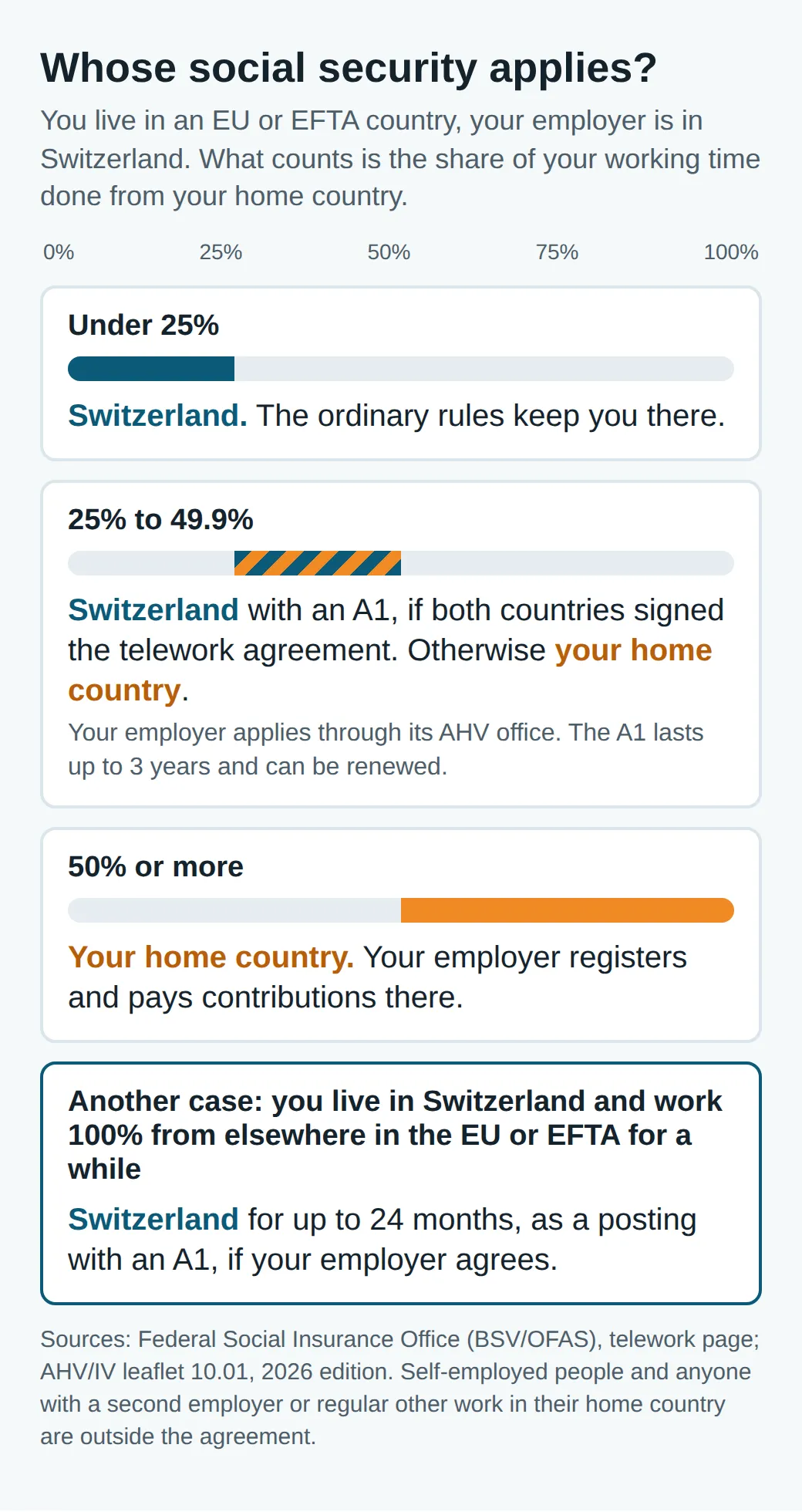
If you live in an EU or EFTA country and work partly from home there, the basic rule is that 25 percent or more of your work in your country of residence moves you into its social security system. Below 25 percent, you stay in the system of the country where your employer is based. The AHV/IV leaflet 10.01 sets this out, and the federal SME portal adds that the share is measured against your total working time, based on what's expected over the next 12 months.
Since 1 July 2023, a multilateral framework agreement has moved that line for teleworkers. Under it, you can work up to 49.9 percent from home in your country of residence and stay insured in Switzerland, as the Federal Social Insurance Office (BSV in German, OFAS in French) explains. It only covers social security, not tax.
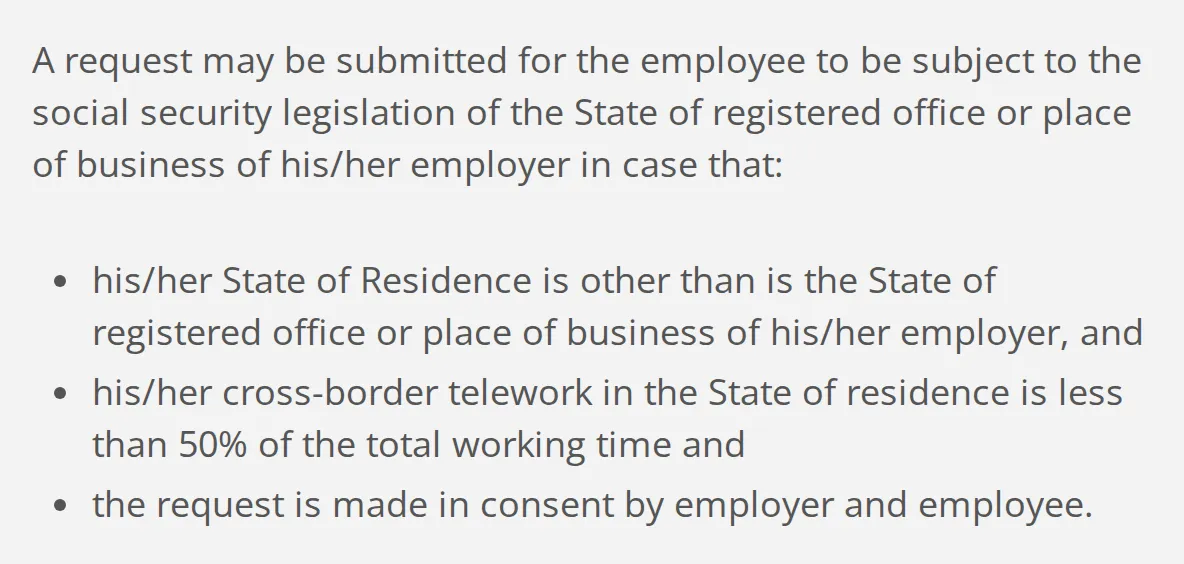
Three conditions decide whether it applies to you. Both your country of residence and Switzerland must have signed. Belgium, which holds the agreement, keeps the list of signatories: today it has 23 entries, Switzerland included, and all of Switzerland's neighbours are on it. Italy joined on 1 January 2024 and Estonia on 1 February 2026. Seven EU members are not on it: Bulgaria, Cyprus, Denmark, Greece, Hungary, Latvia and Romania. Neither is Iceland, and the UK has said it won't sign.
The second condition is that telework is the only thing you do in your home country. The agreement excludes the self-employed, people who regularly do other work in their country of residence (client visits, a side business), people who also work in a third country, and anyone whose employers aren't all based in the same signatory country. The third is consent: the explanatory notes to the agreement say the request is made jointly by employer and employee. Your employer can't be forced into it, and neither can you.
How the A1 works
The A1 is the certificate that proves which country insures you. Your employer requests it from its AHV compensation office through ALPS, the federal online platform for these cases, under the case type for cross-border telework. The BSV page says an A1 is valid for at most three years and can be renewed. It can only be backdated by three months, so a request filed late leaves a gap that the agreement no longer covers. The agreement itself was concluded for five years and renews automatically for five more each time.
Without an A1, the ordinary rules apply. The SME portal is blunt about what that means for a Swiss employer once you cross 25 percent: it must pay contributions to the foreign authority, learn how that country's system works, and those contributions can be higher than Swiss ones. Getting it wrong can have serious consequences for both the company and the employee, even when it was unintentional.
What staying in the Swiss system covers
Staying in the Swiss system means more than your pension account. For employees working abroad under Swiss social security, leaflet 10.01 lists old-age and survivors' insurance (AHV), disability insurance (IV), income compensation (EO), unemployment insurance, the occupational pension fund above a certain annual income, compulsory health insurance and insurance against non-work accidents.
Health insurance is the part people forget. If you live in the EU or EFTA but remain subject to Swiss compulsory insurance, you keep a Swiss health insurer, and the Federal Office of Public Health says your premium is then set by your country of residence. Tell your insurer before you move, so the premium and your cover abroad are set up correctly.
Working abroad full time for a while
The 50 percent rule is about your home country. If you live in Switzerland and want to work from somewhere else in Europe for a few months, a different route applies.
The EU and EFTA states have agreed that temporary, full-time telework from another country can be handled as a posting, the same procedure used when a company sends someone abroad on assignment. The BSV lists the kinds of cases it has in mind: caring for relatives abroad, medical reasons, an office closed for renovation, and the "workation" from a holiday destination. It doesn't matter who suggested it or whether the reason is private. Your employer must agree, applies for an A1 through its compensation office, and the stay can last up to 24 months. Extensions beyond that are generally refused. The route also works for the UK, but generally not for postings under Switzerland's agreements with countries outside the EU and EFTA.
Tax on such a stay is a separate question. The OECD model treaty, the template that tax treaties are drafted from, keeps your salary taxable only in your country of residence when you spend no more than 183 days in the other country in any twelve-month period, your employer isn't based there, and the pay isn't borne by a permanent establishment there (OECD Model, Article 15). The actual treaty with that country is what counts, so check it before you go for long.
Moving abroad and working fully remote
Once you live abroad and do all your work from there, the telework agreement no longer helps you, because it needs at least half your work in Switzerland. Leaflet 10.01 states the rule for Swiss and EU nationals: if you work only in one EU state, you're in principle insured in that state. Your Swiss employer then has to register with that country's social security and pay contributions there.
Outside the EU and EFTA, the picture depends on whether Switzerland has a social security agreement with the country. It has one with 22 states, among them the United States, Canada, Australia, Japan, India and the UK, and these only cover some branches of insurance. Where you live and work in such a country, you're insured there unless your employer posts you temporarily.
Where neither EU rules nor an agreement keeps you in the Swiss system, the AHV has one more door for people working abroad for a Swiss employer: continued compulsory insurance. Leaflet 10.01 sets three conditions. Your salary must be paid by an employer in Switzerland. You must have been insured in the AHV for five full consecutive years right before leaving. And your employer must agree, which it doesn't have to. The request goes to your employer's compensation office within six months of the day you meet the conditions, and after that the door closes for good. It doesn't free you from the other country's system, so you can end up paying into both.
There's also voluntary AHV, open to Swiss, EU, Icelandic, Liechtenstein and Norwegian nationals, but only if you live outside the EU and EFTA. You need five consecutive insured years before leaving, and you have one year to apply, through a Swiss embassy or consulate or the Swiss Compensation Office.
Where you pay income tax
The default is simple: you pay tax on your salary where you physically do the work. The Federal Council's dispatch on telework taxation says tax treaties as a rule tax employment income in the state where the work is physically done, so telework moves the taxing right from the employer's country to the country where you live. It also recalls a Federal Supreme Court ruling, 2C_215/2009 of 1 October 2009. As the dispatch summarises it, pay for the 40 percent of the work done from home abroad could not be taxed in Switzerland, because Swiss law required the person to be physically present.
That ruling is why Switzerland needed new law. The federal act on taxing telework in international relations came into force on 1 January 2025. It lets Switzerland tax home-office days abroad where a treaty gives it that right, and it is limited to the five neighbouring countries. Further away, no such deal exists: if you move to Spain or Portugal, the default rule applies and your salary for work done there is taxed there.
France: up to 40 percent
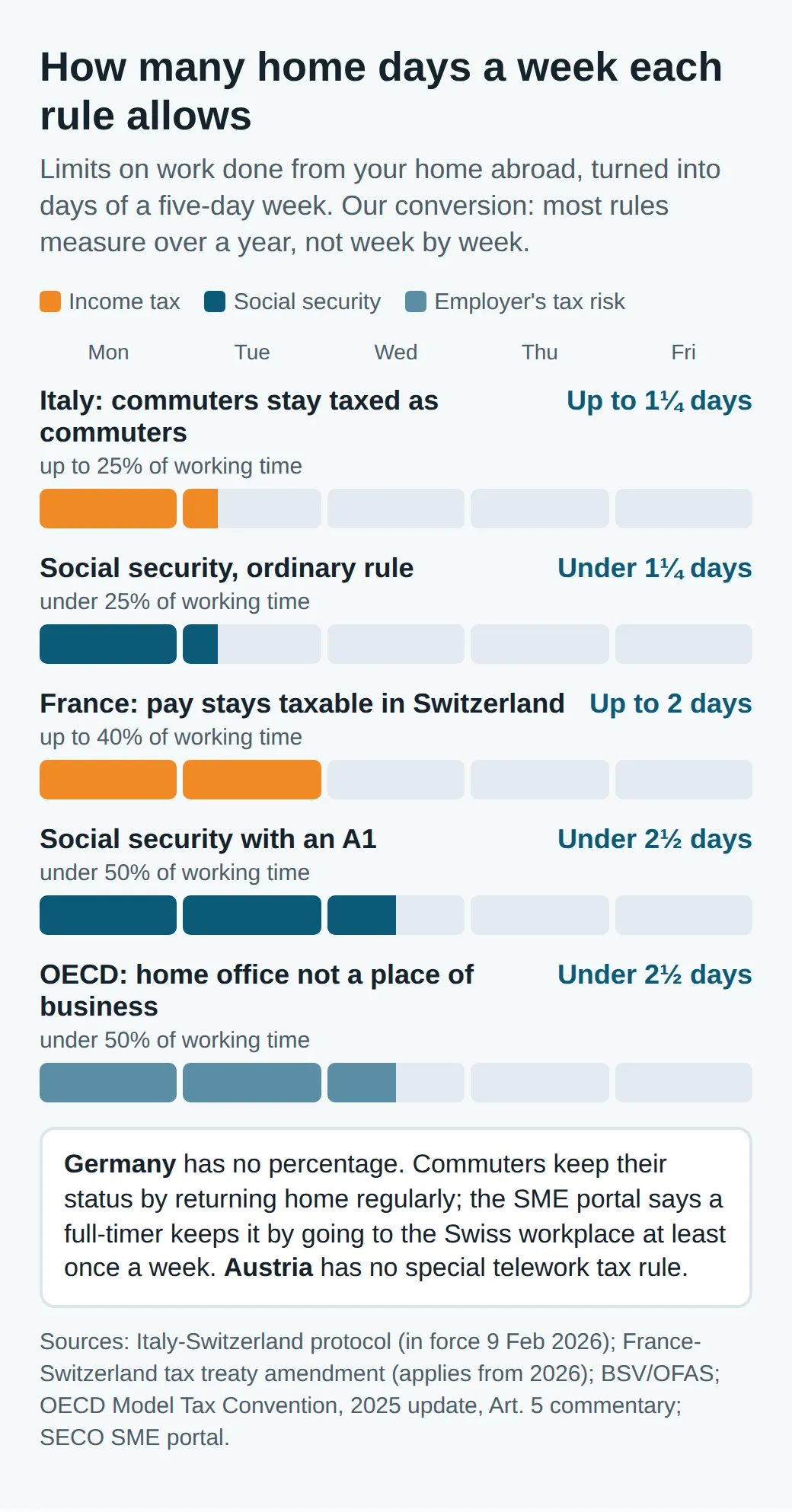
A commuter living in France can work up to 40 percent of annual working time from home without changing how they're taxed. The State Secretariat for International Finance explains that the rule is now set in an amendment to the tax treaty, signed in 2023, whose rules on home-office income apply from 1 January 2026. Until then, a transitional agreement allowed the same share from 2023. For a full-time job, 40 percent is two days a week. The Geneva tax office adds two details: up to ten days a year of temporary assignments, such as business trips, count within the 40 percent, and employers must report each French-resident employee's telework rate to the tax authorities, the first time in January 2027 for 2026. In return, Switzerland pays France compensation and the two countries exchange salary data.
Italy: up to 25 percent
Commuters in the sense of the Swiss-Italian commuter agreement of 2020 can work up to 25 percent of their working time from home without losing commuter status or changing their taxation. The protocol that made this permanent entered into force on 9 February 2026 and applies back to 1 January 2024. Note the gap: social security allows up to 49.9 percent with an A1, tax only 25 percent.
Germany: no percentage, but a weekly trip
The German treaty works differently. For a commuter, Switzerland withholds only a special flat rate of 4.5 percent at source, as the Aargau tax office explains. What decides commuter status is returning home regularly. You lose it with more than 60 days a year on which you can't go home for work reasons, and then Switzerland's taxing right is no longer limited. There is no telework percentage. The SME portal says a full-time employee keeps commuter status by going to the Swiss workplace at least once a week.
For Austria, the SME portal says commuters have no special telework tax rule: pay for days worked from home in Austria is taxable there.
Your permit: what it covers and when it lapses
A Swiss permit is about living and working in Switzerland. It gives you no right to live anywhere else, and it doesn't survive a long absence.
If you hold a B or C permit and leave without deregistering, the B lapses after six months abroad, and so does the C, according to the Aliens and Integration Act as quoted by Zurich's migration office. Short visits back to Switzerland don't restart the clock. Deregistering ends the permit straight away, unless you ask at the same time to keep a C permit. A C permit can be kept for up to four years if you ask before the six months run out, and the same office's directive says it grants this only if you really intend to return.
Going the other way, an EU or EFTA citizen who lives abroad and comes into a Swiss office some days needs a cross-border commuter permit (G). The State Secretariat for Migration says commuters must return to their main home abroad every day or at least once a week, and there are no longer border zones for EU and EFTA citizens.
Whether you may live in the country you're moving to is that country's question, so check with its immigration office before you sign a lease. If you aren't a Swiss, EU or EFTA national, mind one more detail: leaflet 10.01 points out that non-EU nationals living and working in the EU aren't covered by the AHV at all unless they're posted from Switzerland.
Why your employer may hesitate
When a Swiss company says no to working from abroad, the reason is often not you. It's the risk that your home office becomes a taxable presence of the company in another country, a permanent establishment, which could expose part of its profit to that country's tax.
The OECD settled much of this in its 2025 update to the Model Tax Convention. A home would generally not count as the company's place of business if you work from it less than 50 percent of your total working time over any twelve-month period. At 50 percent or more, it depends on the facts, and the main test is whether the company has a commercial reason for you to be in that country, such as meeting its customers there, building a client base or managing suppliers. Letting you work from home only to keep you, or only to save office costs, is not a commercial reason. The OECD's own example: an employee working from home 80 percent of the time who regularly visits the company's clients in that country creates a permanent establishment. One working from home 30 percent of the time does not.
Two more worries come up. Paperwork: once you're insured abroad, the company has to deal with that country's social security directly, as the SME portal warns. And labour law: the SME portal advises that the contract should state which country's labour law applies, because Swiss law can be questioned when a large part of the work is done abroad.
How to ask, and what to agree in writing
Your best chance is a request that answers the employer's questions before they're asked. Say where you'll live, how much of your time you'll work from there, for how long, and that you'll keep the share below the limit that matters. Offer to keep a record of where you work.
Dear [manager], from [month] I plan to live in [town, country]. I'd like to work from home there two days a week, which is 40% of my working time, and to be in the Zurich office the other three. [Country] has signed the telework agreement, so I'd ask you to request an A1 through our AHV compensation office so I stay in Swiss social security. I'm not doing any client work from there. I'm happy to log my home days and to put the arrangement and the applicable labour law in an annex to my contract.
Then get the result on paper: an A1 for social security, a written telework arrangement with the agreed share, and, if you're moving, a decision about your Swiss permit before the six months are up.
If you're still looking for that employer
Employers' policies on working from abroad differ, so raise it in the interview rather than after you've signed. Our board lists current openings in software engineering below and in IT operations.
If an employer you like says no, ask which of these limits worries it. The answer is often a share of home days you can promise to stay under, and that's an easier conversation than a flat yes or no.
Common questions
- Does the 50 percent rule work if I live in the UK?
- No. The United Kingdom has said it will not sign the telework agreement, so the ordinary rules decide which country insures you. The Federal Social Insurance Office notes one exception that does reach the UK: if you live in Switzerland and work full time from the UK for a limited period, that stay can be treated as a posting of up to 24 months with an A1.
- I freelance for Swiss clients. Does the telework agreement cover me?
- No. Self-employed people are outside the agreement. The ordinary rules apply instead, and if you work only from your home country, you are in principle insured there. Your Swiss clients have no part in it.
- I also have a small job in my home country. Does that matter?
- Yes. The agreement does not apply if you regularly do other work in your country of residence, and a job with a local employer counts as such work. Then the ordinary rules apply, and if 25 percent or more of all your work is done in your home country, you are in principle insured there for all your jobs.
- Is the percentage counted per week or per year?
- Over a longer period. The federal SME portal says the 25 percent test looks at what is expected for the next 12 months, France's 40 percent counts annual working time, and the OECD looks at any twelve-month period. What matters is the pattern you and your employer plan, so put it in writing.
- Can I keep my Swiss C permit while I try living abroad?
- Possibly. A C permit lapses after six months abroad, but if you ask the cantonal migration office before those six months are up, it can be kept for up to four years. Zurich's migration office grants this only if you really intend to come back. A B permit has no such option.