Home office allowance in Switzerland: who pays the rent?

Before you ask HR
Your employer pays a share of your rent only when your home stands in for an office it should have provided. Swiss law makes employers repay every expense the work necessarily causes, and the Federal Court counted a share of rent among them for a worker who had no suitable desk at the company. If a desk waits for you at the office and you choose home, no rent share is owed.
Many pages on this question repeat a figure from news reports in 2020, CHF 150 a month, and stop there. The ruling behind it is public, and it says more than the headline: the worker was a part-time helper on about 7.5 hours a week, his room doubled as the firm's archive, and the court said it made no difference that he would have paid that rent anyway. We read the ruling, the Code of Obligations and what two public employers pay their own staff, and set out what your contract can and cannot take away from you.
Two articles, two different rules
Swiss law splits the cost of working from home into tools and expenses, and treats them very differently. Tools are the things you work with: laptop, screen, headset, desk, chair. Expenses are the money the work costs you along the way: a share of your rent, extra electricity, phone and internet.
| Rule | What it covers | Can your contract change it? |
|---|---|---|
| CO art. 327 | Tools and materials | Yes, by agreement or custom |
| CO art. 327a | Expenses the work necessarily causes | Only in your favour |
For tools, the employer supplies what the work requires "unless otherwise provided by agreement or custom". If you use your own with the employer's consent, you are owed appropriate compensation, again unless something else was agreed. So a contract that says you bring your own laptop and get nothing for it is allowed.
Expenses are a different matter. The employer "must reimburse the employee for all expenses necessarily incurred in the performance of the work", and any agreement that you bear all or part of those necessary expenses yourself is void. The law also lists this rule among those that no contract may change to your disadvantage (CO art. 362). A contract may replace your actual costs with a fixed sum, a daily rate or a monthly allowance, but only in writing and only if that sum covers all the necessary expenses.
Everything therefore turns on one word: necessary. Is the rent for the room you work in a cost the job causes, or a cost of your private life that you would carry anyway? That is the question the Federal Court answered in 2019.
The 2019 ruling: a room that doubled as an archive
In ruling 4A_533/2018 of 23 April 2019, the Federal Court confirmed that an employer had to pay part of a worker's rent, although nothing about it was in his contract. The facts are modest, and that's what makes the case useful.
The employer was a sole proprietor working in fiduciary services, bookkeeping and tax. The worker had helped out since October 2014, and from 1 July 2015 he had a written contract: CHF 937.75 net a month for 32.625 hours, which comes to about seven and a half hours a week. He did the work from a room in his own flat, which also stored the firm's files. The relationship broke down over unpaid wages, the employer dismissed him with immediate effect on 13 April 2016 without a valid reason, and in August 2016 he sued at the district labour court in Zurzach.
He won a large part of it: wages, overtime, a penalty for the unjustified dismissal, and CHF 1,425 for the use of his room as an office and archive. The Aargau high court upheld that in July 2018. The employer took it to the Federal Court with a simple argument: the contract said nothing about renting an office or an archive, so nothing was owed.

The court disagreed on every point. The duty to pay arises from the law itself, so no agreement was needed. It was undisputed that the employer had no suitable workplace for him, and in that case, the court held, the work setup at home is necessary for the job and has to be reimbursed under art. 327a. It then rejected a view found in some legal writing, that a worker who did not rent the flat for his home office gets nothing because he would have paid the rent anyway. The court called that view nicht sachgerecht, not appropriate, and agreed with writers who compare it with using your own car for business trips, which the law explicitly pays for.
The employer also attacked the amount, and lost there too. The worker does not have to prove his expenses to the franc, the court said, because splitting one room between private use and work can't be measured exactly. Expenses that are real but cannot be proven in figures are estimated by the judge. The Aargau courts had split the room's use in percentages, office and archive on one side and private use on the other, and estimated the compensation at CHF 150. The ruling doesn't say for what period; news reports gave it as a monthly sum, and the CHF 1,425 award is nine and a half times that amount. The employer was also ordered to pay the Federal Court's fee of CHF 500.
Does it matter who wanted the home office?
Less than most articles suggest. News reports in 2020 framed it as home office at the employer's request, but the test the court applied was whether the employer gave the worker a permanent, suitable workplace. Who first suggested working from home matters only as a clue to that.
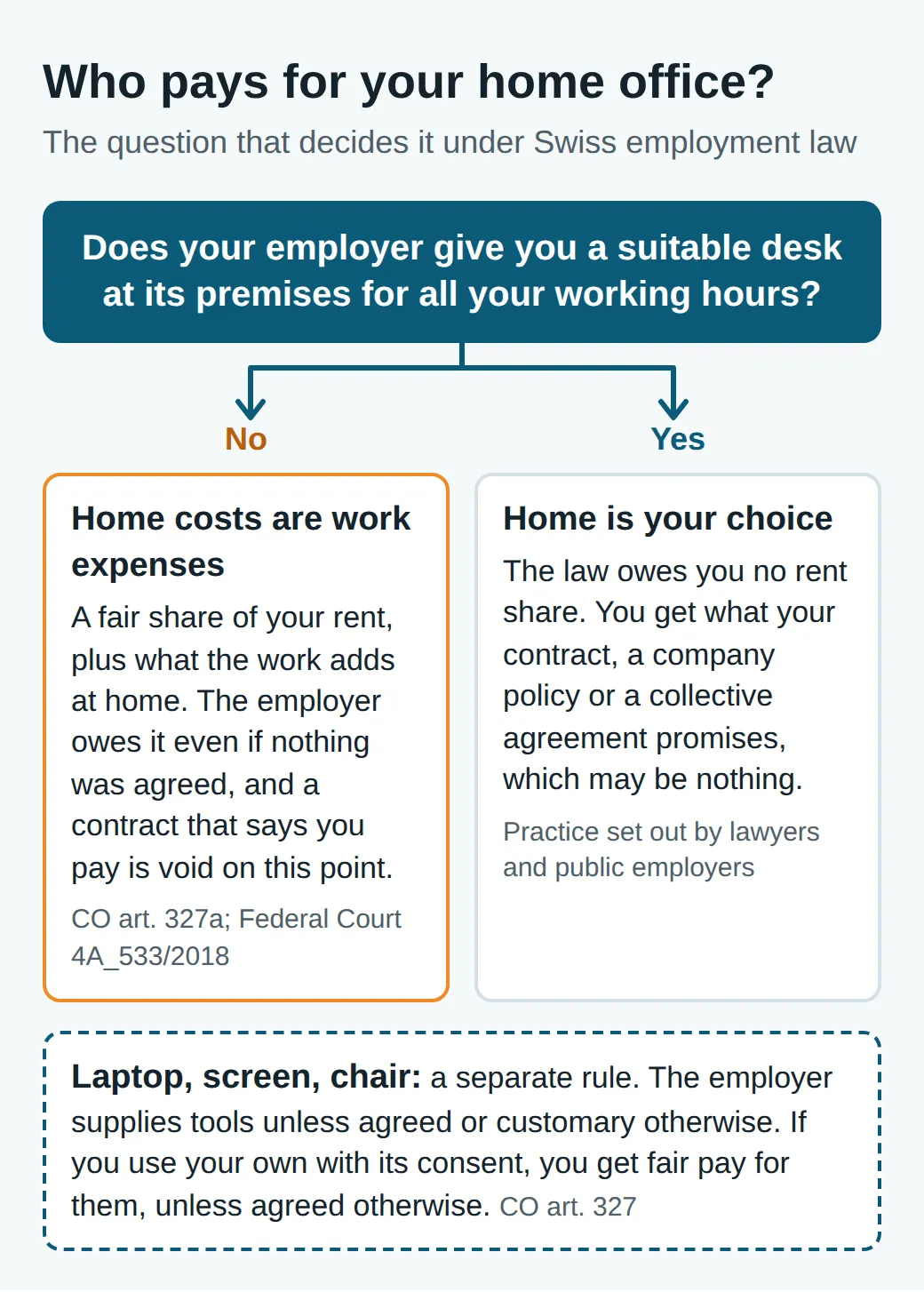
If you were hired as a fully remote employee, if the company gave up its office, or if it runs desk sharing with fewer desks than people, your home is doing the office's job. Those home costs are caused by the work. If a desk is waiting for you every day and you prefer the kitchen table, the costs come from your choice. The law firm CMS sums up practice in its guide to remote working in Switzerland this way: where suitable office space is provided and remote work is voluntary, no allowance is owed.
Public employers draw the same line in their own rules. Canton Zurich's leaflet on mobile work describes it as voluntary and as a complement to the usual workplace. It gives no entitlement to expenses or other compensation, private infrastructure is not paid for, and neither is a coworking space you rent of your own accord. The canton usually supplies the computer, and staff provide the rest. The federal administration, by contrast, pays a flat allowance, but only to staff who no longer have a desk at its premises for all their contracted hours.
The grey zone is the word "suitable". The ruling doesn't define it. A desk in a city two hours away, or a flex desk you can rarely book, is a weaker answer than a desk with your name on it. If your situation sits in between, write down what you have been offered and raise it before costs pile up.
What counts: rent, power, internet, furniture
The 2019 case was about rent, because that was what the worker claimed. Art. 327a itself is wider: it covers every expense the work necessarily causes. The law doesn't list what that includes for a home office, so the most useful guide is what an employer itself counts.
The federal government's rule for its own staff, art. 51c of the finance department's ordinance on federal staff, says its flat allowance covers the share of rent for the private rooms used, furniture, higher electricity use, means of communication and any other extra costs. That is a fair checklist for your own claim.
Internet is the hard case. If you would have had the same flat-rate subscription without the job, the extra cost is close to zero. The court's reasoning on rent, that you can't be refused because you'd have paid anyway, points towards a share all the same, but we found no ruling that applies it to internet. Furniture is the other borderline item: a desk and a chair are tools under art. 327, which a contract may leave to you, while the federal rule counts furniture inside its expense allowance.
How much is a fair share?
No law or court has set a rate. The CHF 150 from 2019 was one judge's estimate for one room in one flat, not a tariff, and the best you can do is compare a few real numbers and then work out your own.
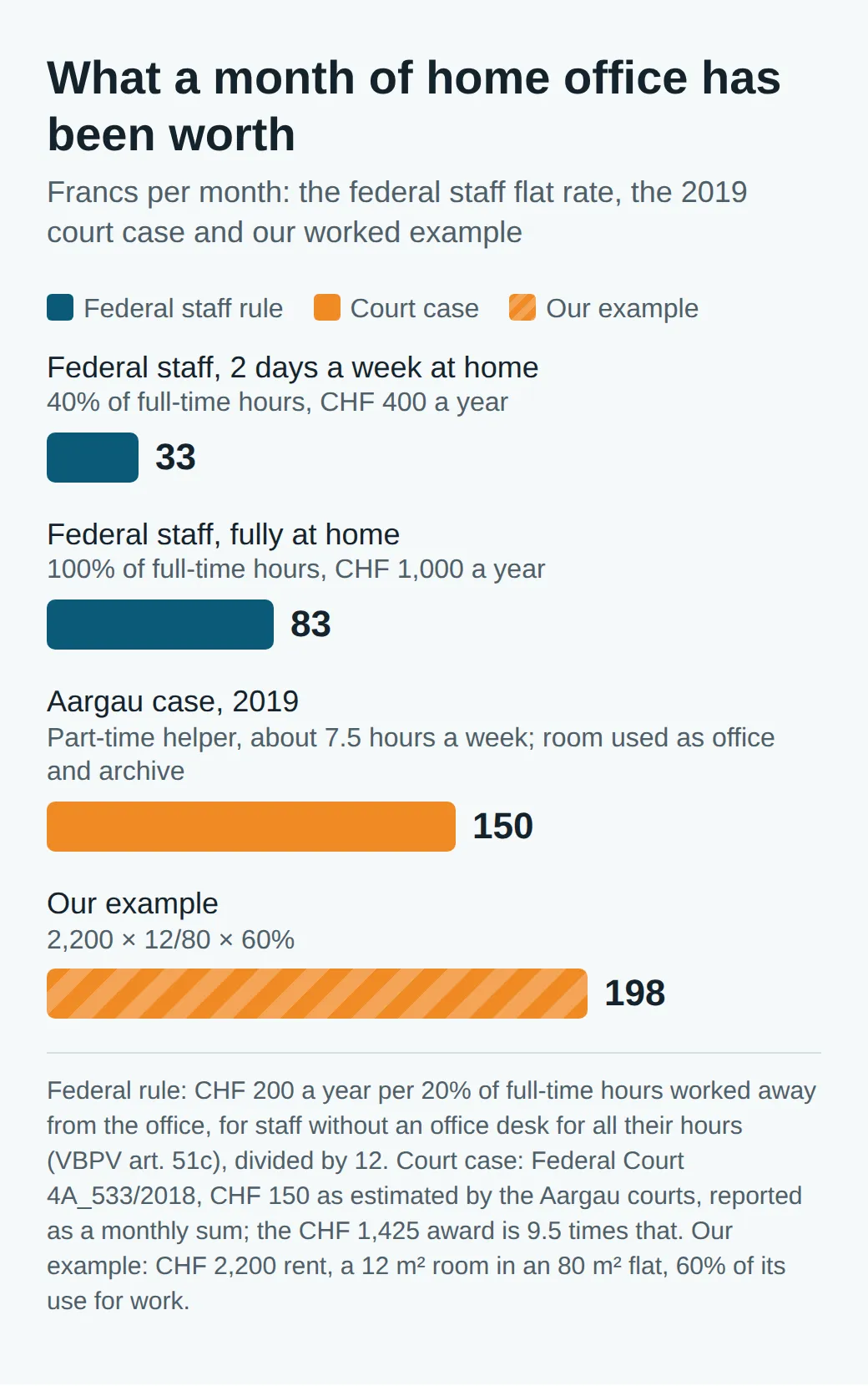
The federal rule pays CHF 200 a year for every 20 percent of a full-time year worked away from the office. Two days a week at home is 40 percent, so CHF 400 a year, or about CHF 33 a month. Working fully from home brings CHF 1,000 a year, about CHF 83 a month. Part-time staff get a smaller amount in line with their hours. That's one employer's flat rate, set by ordinance for federal staff, not a standard for private contracts. It shows what one large employer thinks the costs are worth, but it doesn't cap what you can claim.
The Aargau courts split the room's use in percentages. Add the room's share of the flat and you have a method you can copy: your rent, times the share of the flat the work space takes up, times the share of that space's use that is work. In our example, a flat of 80 square metres costs CHF 2,200 a month including service charges. The study is 12 square metres, and you use it for work 60 percent of the time. That gives 2,200 × 12 ÷ 80 × 0.6, or CHF 198 a month. Your figures will differ, and a judge would make an estimate of their own, but this is the shape of a claim your employer can check.
Contract clauses that hold, and those that don't
Your contract or the company's home office policy decides a lot, but only within the limits of art. 327a. Here's how common clauses fare:
- "Home office is voluntary. Your desk at the office remains available and no compensation is paid." This holds, as long as the desk really exists.
- "The employee bears all costs of working from home." Void for necessary expenses if you have no suitable desk at the office. It can still cover costs that aren't necessary, such as a nicer chair you chose.
- "A flat CHF 50 a month covers all home office costs." Valid if it's in writing and actually covers your necessary expenses. If it falls short, you can claim the difference.
- "The employee uses their own laptop and phone without compensation." Allowed, since the tools rule gives way to an agreement.
Collective agreements and standard employment contracts can also set flat sums for expenses, under the same condition that they cover all necessary costs. And there's no general right to work from home in the first place: without a clause in your contract or a policy, the employer decides whether you may.
How to claim it
Claim it in writing, with a short statement of your costs, and do it early. The law says expenses are repaid with your salary on the basis of your statement (CO art. 327c), and if you have regular expenses, the employer has to pay an advance at least once a month.
You cannot validly give up a claim that rests on a rule the contract cannot change while you are employed and for one month after (CO art. 341). So a signature under "I have no further claims" in that period does not end it. Claims from an employment relationship lapse after five years (CO art. 128). The worker in the 2019 case went to court for his room only after he had been dismissed, and still got it.
A short, factual email is enough to start:
Dear [manager], since [month] I have worked from home [number] days a week, as I have no desk of my own at the office. I use a [12] m² room in my flat for this, about [60]% of the time. Based on my rent of CHF [2,200], I estimate the work share at CHF [198] a month, and I'd like to agree an allowance under art. 327a of the Code of Obligations from [month]. I'm happy to show you the figures.
If your home office is in another country, social security and tax rules come on top of all this, and we cover those in our guide to working from abroad for a Swiss employer.
Before you sign a remote contract
The cheapest moment to settle this is before you start. Ask whether there is a desk for you at the office and for how many days, and whether the company pays a home office allowance. If the role is fully remote and the answer is no, you know the law is on your side, and you can raise it calmly rather than after a year of paying for the company's office yourself.
The 2019 case came from a small bookkeeping firm, and finance roles are among those our board lists with remote or hybrid work.
When you compare offers, count an allowance like any other part of the pay. Two employers offering the same salary aren't offering the same deal if only one of them pays for the room you'll be working in.
Common questions
- Does my employer have to give me a laptop and a screen?
- By default, yes. The Code of Obligations says the employer supplies the tools the work needs, unless something else has been agreed or is customary. If you use your own equipment with the employer's consent, you are owed fair compensation for it, but a contract can also take that away, so read yours.
- Can I still claim home office costs after I have left the job?
- Yes. Claims from an employment relationship lapse after five years, and the worker in the 2019 case went to court only after he had been dismissed. While you are employed and for one month after, you cannot validly waive a claim that comes from a rule the contract cannot change, and the expense rule is one of them.
- I work part time. Is my share smaller?
- It depends on how much the room is used for work, not on a fixed formula. The worker in the 2019 case had a contract for about 7.5 hours a week and still got a share of rent, partly because the room also held the firm's files. The federal flat rate for its own staff is reduced in line with part-time hours.
- My employer pays a flat amount that is lower than my real costs. What can I do?
- A flat sum is allowed only if it covers all the expenses the work necessarily causes. Keep a short record of your costs, show it to your employer in writing and ask for the difference. If you have no suitable desk at the office, a clause saying you carry the rest yourself is void.
- Does my employer pay if I work from a coworking space?
- Not if a desk is waiting for you at the office and coworking is your own choice. Canton Zurich, for example, tells its staff that a coworking space they rent voluntarily is not paid for. If you have no suitable desk at all, a coworking membership can be a work expense, but agree it with your employer before you sign up.
More posts
All posts
Work remotely from abroad for a Swiss employer: 2026 rules
Working abroad for a Swiss employer in 2026: the 25% and 50% social security limits, the A1, tax in France, Italy and Germany, permits and employer risk.