Remote job scams in Switzerland: how to spot them (2026)

Before you reply
A remote job is a scam if it asks you to pay, to let money pass through your bank account, or to forward parcels. In Switzerland these offers come as task platforms, money mule jobs and, more rarely, fake cheques. A real employer pays you, covers your work expenses by law and never needs your account for its own money.
Most of what you'll find on this question is written for the United States. It sends you to the FTC or the FBI and spends a lot of time on cheques, which Swiss banks rarely see. The Swiss picture differs in three ways that matter: the scams now borrow the names of real Swiss companies, Swiss criminal law can hold you liable for forwarding money even when you didn't know for sure where it came from, and you report to your cantonal police and the National Cyber Security Centre (NCSC), the federal office that collects these cases. We went through the NCSC's warnings from 2023 to 2026, police case files from Zurich and Fribourg and the federal rules on wages and job agencies, and put them in the order you would meet them.
What Swiss authorities are seeing
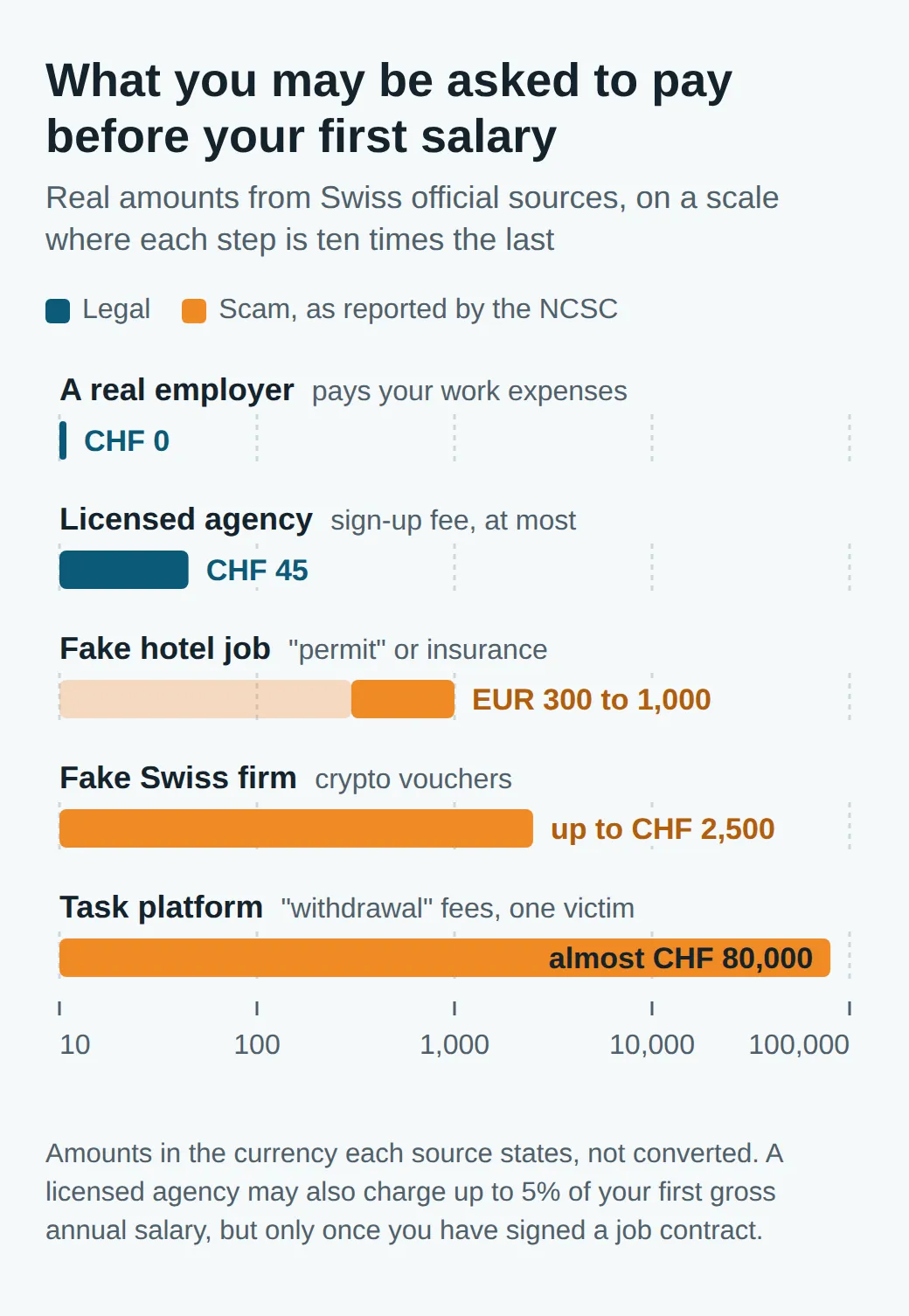
The scams have gone from crude to convincing in about three years. In 2023 the NCSC described the older version: fake hotel jobs, posted mostly on Italian and Greek job platforms, that asked applicants for EUR 300 to 1,000 upfront for a supposed Swiss work permit or for health and accident insurance. The newer kinds start on social media, by email or on job sites, move to a messaging app such as WhatsApp, and only ask for money once the "work" has begun.
In June 2025 the NCSC saw a rise in reports of fake jobs offering easy online tasks with flexible hours, often in the name of retailers such as Manor, Zalando or About You. One victim lost almost CHF 80,000, their entire life savings. In December 2025 the Zurich cantonal police described, on its cybercrimepolice.ch case page, applicants who sent ID copies and bank details through a chat, received a professional-looking contract and were told to open a new bank account or crypto wallet for the job's payments.
The newest version, which the NCSC published in March 2026, is the hardest to spot. Scammers pick a company that really exists in the commercial register but has no website, build a website for it from the register data, and advertise its jobs on legitimate job platforms and even in printed newspapers.
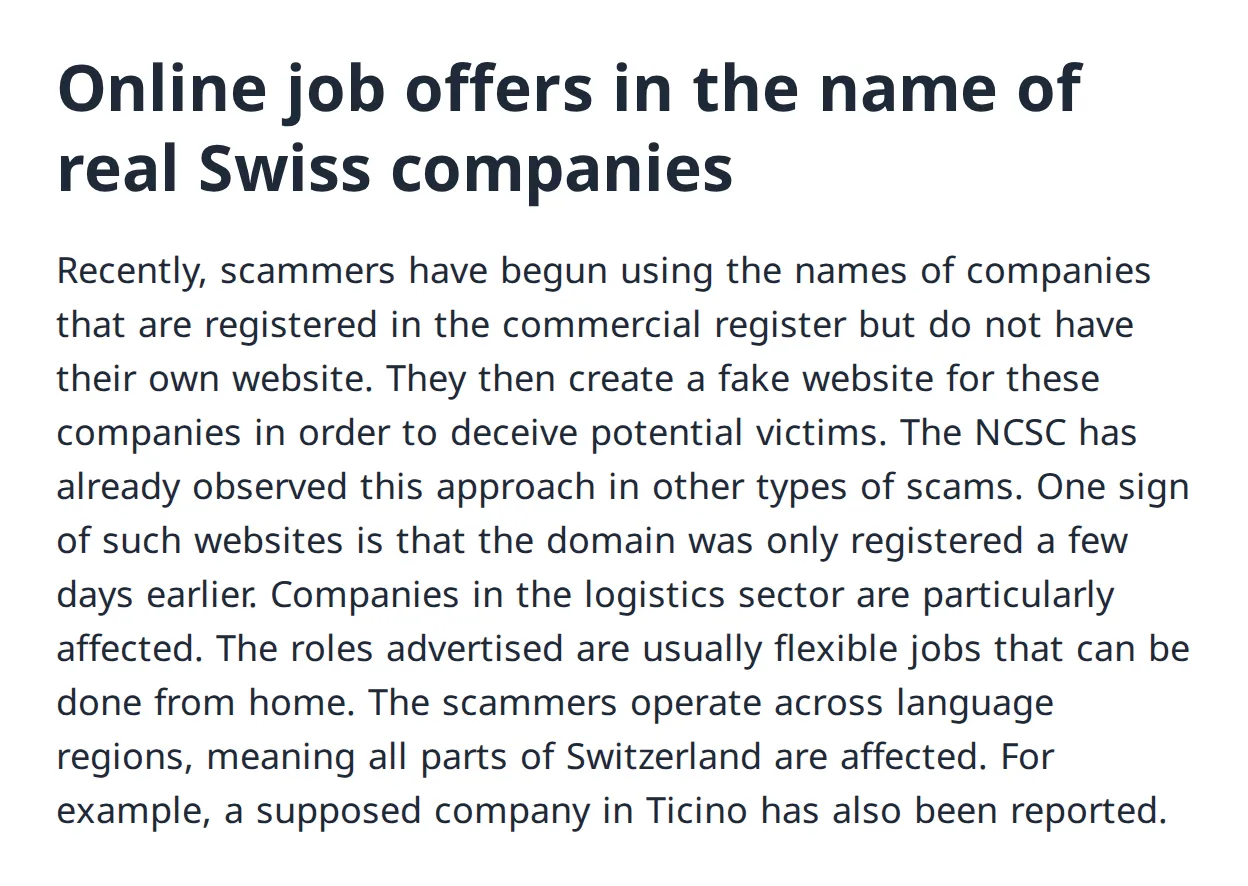
The jobs on those sites sit behind a password that applicants only get once they apply, which keeps out anyone checking, the authorities included. Applicants were told to install the messaging app Element and to upload their CV, references and diplomas. In one case the "employer" asked the applicant to buy Cryptonow vouchers worth up to CHF 2,500 and promised to pay the money back later. The NCSC says the final aim isn't fully clear yet, but the scammers end up with a full set of personal documents either way.
By June 2026 the NCSC was warning job seekers about three more tricks: a fake login window disguised as a calendar invitation for a phone interview, an ad posing as a "Swiss social welfare" programme that offered parcel handling from home and asked for ID photos and a home address, and a recruiter on LinkedIn whose coding test installed malware.
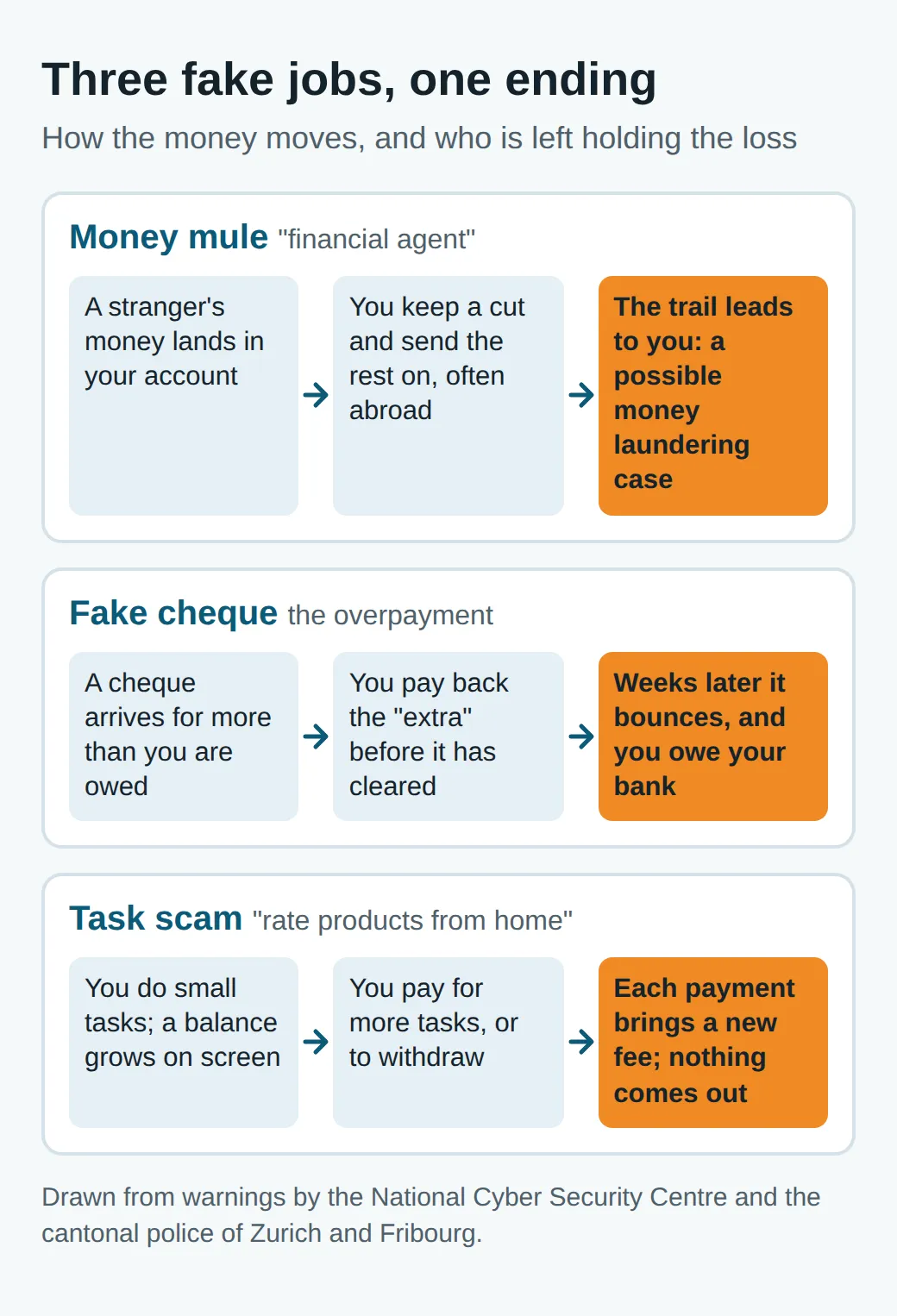
For scale: Swiss police registered 54,247 offences of online economic crime in 2025, with 36,572 people harmed, according to the Federal Statistical Office. That covers every kind of online fraud and only the cases that reached the police, and the published figures don't count fake jobs separately. Underneath all the variety, though, the money moves in only three ways.
How task scams work
A task scam pays you in numbers on a screen and charges you in real money. The work is the kind the NCSC lists again and again: writing reviews, buying products, recommending fashion items, testing apps. After you're recruited, you're sent to a platform that supposedly manages your salary and bonuses. Your earnings are credited there and nowhere else.
The NCSC's descriptions from 2023 and 2026 show what happens next. The free tasks quickly run out. To keep going without waiting, you're invited to pay a small fee for more. When you try to withdraw what you've earned, a new fee appears, then another, until you stop. A variant lets you take out small amounts at first, which builds trust. Then you're told your profit is too low for a "super bonus" unless you deposit your own money, while fake colleagues in a WhatsApp group talk about the huge bonuses they've received. Every deposit lands only on the fake balance, and the demands grow each round.
The CHF 80,000 case from 2025 followed this script. The victim was offered remote work for a supposed travel agency, putting together travel packages for a commission. The commissions showed up on the platform but could never be withdrawn. Each attempt needed a deposit to "activate" the withdrawal, and each deposit brought a new fee. It went on for five months. Another fake platform, supposedly for reviewing apps, claimed it would pay in a cryptocurrency.
So a first small payout proves nothing. It's part of the design, and it's what makes people pay the larger amounts that follow. The second kind of fake job never asks you for money at all: it borrows your bank account.
Money mule jobs: when the job is your account
In a money mule job, money from strangers arrives in your account, you keep a small commission and send the rest on, often abroad. The NCSC's money mule page says the money usually comes from crime. The Fribourg cantonal police describes the ads: tempting offers on online platforms and classified sites for "financial agent" roles that need no training or skills.
This is the scam where you face the law, not only a loss. Article 305bis of the Swiss Criminal Code punishes anyone who makes it harder to trace money that, in the German text's words, they weiss oder annehmen muss, "know or must assume", comes from a serious crime. The penalty is up to three years in prison or a monetary penalty, and up to five years in serious cases. The words "must assume" are the catch: the law does not only ask whether you knew, but also whether you should have suspected. A job that pays you to move strangers' money is the kind of situation where that question gets asked.
This isn't theoretical. In a European action against money mules in autumn 2018, coordinated by Europol and, for Switzerland, by the federal police fedpol, ten cantonal police forces took part. The Zurich cantonal police alone identified 31 money mules who had moved more than CHF 650,000 for criminal groups, and opened proceedings against them for helping with money laundering. They had been recruited with high pay, home working and flexible hours, through ordinary job sites and fake company websites. The police's advice at the time still holds: a real employer usually invites you to an interview and never asks for your private account to handle its business payments. One line of that advice sums it up: Verzichten Sie im Zweifelsfall!, "if in doubt, say no."
Two variants work the same way. In the first, money appears in your account unexpectedly, and someone claims it was a mistake and asks you to send it on. In the second, you receive and forward parcels instead of money. The NCSC links these parcel jobs to laundering through reshipping, and warns that the ID copies collected along the way can be used to order expensive goods with stolen credit cards.
Fake cheques, and why you'll rarely see one here
American guides spend a lot of time on fake cheques. In Switzerland they are rare: the NCSC noted in 2024 that it had received only one cheque scam report so far that year, because cheques are hardly used here. The mechanics are simple. You receive a cheque for more than you're owed and are asked to send back the difference before it has cleared. The NCSC's page on overpayment fraud warns that a bank can take several weeks to confirm whether a cheque is covered, and that you are generally liable to the bank if it bounces.
The Swiss versions keep the idea and swap the cheque: vouchers you buy now with a promised refund later, as in the Cryptonow case, or equipment you pay for yourself with a promise of reimbursement. Swiss employment law makes that second request a red flag on its own. Under the Code of Obligations, your employer must, unless agreed otherwise, provide the tools and materials you need for the work (Article 327). It must also pay back all expenses the work makes necessary (Article 327a), and an agreement that you carry those expenses yourself is void. Our guide on whether your employer must pay for home office goes into what that means for a desk at home. For spotting a scam, the rule is enough: a real employer doesn't make you pay to start working, which brings us to what a real job can cost you at all.
What a real job can cost you up front
From an employer, nothing. From a job agency, very little, and only on fixed terms. The federal Job Placement Act allows a private agency to charge you a registration fee and a placement commission, but the commission is due only once the agency's work has led to a signed job contract. The fee ordinance caps both: the registration fee at CHF 45, charged only once per placement order, and the commission at 5 percent of your first year's gross salary, plus VAT.
Agencies that place people regularly need a licence from the canton's labour office, and one from the State Secretariat for Economic Affairs (SECO) as well if they place people across the border. Placing people without one can bring a fine of up to CHF 100,000. SECO and the cantons keep a register of licensed agencies with over 7,400 firms in it, so you can check whether a "recruiter" who wants a fee has a licence at all.
Set against those limits, every fee a fake job asks for falls outside the rules: a "processing fee" before any contract, a permit fee paid to a stranger, a voucher you'll be refunded for, a deposit to release your wages. If someone wants money from you before your first payslip, you have your answer. The harder cases are the offers that don't ask for money yet, and that's where the warning signs below help.
Red flags, in the order you meet them
Scams rarely show every sign at once, and the signs tend to appear in roughly this order, from the first ad to the first payment. These come from the NCSC's warnings and the two police case files above.
- The pay doesn't fit the work. Unusually high earnings for reviews, app tests or "flexible" home tasks.
- The chat moves. Contact starts on a job site or social media, then shifts to WhatsApp, Telegram or Element.
- There's no real interview. Just a chat, or a "call" that turns into a login page.
- Documents come before the offer. The NCSC advises sharing ID copies and bank details only after you have a job offer.
- You're told to open a new account or crypto wallet for the job's payments.
- Money arrives before work does, or you're asked to forward any money or parcels.
- You pay to work. Fees, deposits, vouchers, "activation" or "release" charges.
- Your wage exists only on a website. Swiss law says wages are paid in legal currency, unless agreed otherwise, with a written pay statement.
- The company's website is days old, or its job page needs a password.
- A test asks you to run code from a private repository or paste a command.
One sign alone can have an innocent reason. Two or three together, and especially any request for money or your account, should end the conversation.
How to check an offer that might be real
The best check costs you one phone call. Find the company's official website yourself, not through the link in the message, and call the number listed there to ask whether the job exists. That's the NCSC's own advice, and it beats any amount of reading between the lines of an ad.
Be careful with the commercial register. An entry proves that a company exists, not that it posted the job. The 2026 scam was built precisely on registered companies that had no website of their own, so a real register entry plus a brand-new website plus contact only by chat app is the pattern to look out for, not a reassurance. For agencies, the SECO register shows whether they're licensed.
If the offer survives those checks, ask for a call or video interview with a named person and a written contract that names the employer and your salary in francs. If the other side refuses, or starts to rush you, treat that as your answer.
If you already replied, paid or forwarded money
Act the same day. Stop all payments and transfers, and stop replying. The Fribourg police suggests that if you're in the middle of forwarding money, you simply stop and give administrative or technical reasons for the delay rather than arguing.
Call your bank straight away. The NCSC says a bank may be able to stop a payment if you're quick. The Zurich police advises having all affected accounts and cards blocked and changing every password you used for the application or for online banking. A short message helps you get it right under stress:
I need to report possible fraud on my account [IBAN]. On [date] I received CHF [amount] from [sender], and on [date] I sent CHF [amount] to [recipient] at the request of a supposed employer. Please stop any pending transfers, block the account and card if needed, and tell me what you need for my police report.
Keep everything: the ad, emails, chats, contracts, screenshots of the platform and your payment receipts. Then report it to your cantonal police; the Zurich police asks people to phone ahead before coming in to file a complaint, and the NCSC links to Suisse ePolice to find your nearest station. Report even if you forwarded money yourself. The NCSC says so explicitly: someone who acted as a money mule without meaning to should still report the crime to the police. You can also file a report with the NCSC through its online form; where an account number (IBAN) has been misused, the NCSC can pass it on to law enforcement.
Then expect a second attempt. Fraudsters go back to people who have already lost money with fake "recovery" offers, and the NCSC had received 462 reports of them in 2025 by late December, against 91 in the whole year before. They promise to get your money back for an advance fee, sometimes posing as Europol, Interpol or the NCSC itself, or using the financial regulator FINMA as bait. The NCSC's advice is short: never pay in advance to get lost money back.
Looking for remote work that is real
Real remote jobs look dull next to the scams: an employer with a name you can call, a contract, a salary in francs and an interview with a person. The listings above are a good place to compare what a genuine offer contains. If you work in tech, our software engineering jobs are another place to start, and the same rule applies to every one of them: you should never have to pay, forward or install anything to get hired.
Common questions
- Can a recruiter who contacts me on LinkedIn be a scammer?
- Yes. In June 2026 the NCSC described an IT professional who was approached with a job offer, sometimes from a hacked but genuine-looking profile. The technical test meant running commands from a private GitHub repository, and that code installed malware that reads saved logins, browser cookies and crypto wallets. Never run code or commands from someone you have not checked, and stop if your antivirus or browser warns you.
- Money arrived in my account by mistake and someone wants it sent on. What should I do?
- Send nothing and stop all contact. The NCSC lists this as a variant of the money mule scam: the payment comes from a victim, and forwarding it makes you part of the chain. Tell your bank and the police about the transaction instead.
- Is it legal to be paid in cryptocurrency in Switzerland?
- Swiss law says wages are paid in legal currency unless something else is agreed or customary, and that you get a written pay statement. So a crypto salary is not banned outright, but it is unusual. A job where your pay exists only as a balance on a website, and you must send crypto to get it out, is the pattern of a task scam.
- Is a job ad safe if it appears on a big job site or in a newspaper?
- Not by itself. The NCSC found fake ads on legitimate job platforms in 2026, and for the first time in the job section of printed newspapers. Where an ad appears tells you nothing about who placed it. Check the company yourself, through a number on its own long-standing website, before you send documents.
More posts
All posts
Digital nomad visa in Switzerland: the legal routes in 2026
Switzerland has no digital nomad visa. What the law allows instead: the 90/180 rule, the 8-day limit, EU residence without a job, quotas and staff leasing.

Right to work from home in Switzerland: the rules in 2026
Switzerland gives you no legal right to work from home. When your employer can order you back, when it needs your consent or notice, and what protects you.

Remote companies in Switzerland 2026: what the ads promise
Which Swiss employers post the most remote-friendly jobs, what 536 of their ads promise about home office, and the 42% posted by agencies.