Remote companies in Switzerland 2026: what the ads promise

From our own board
On 19 October 2026, the employers with the most remote-friendly listings on our board were Audemars Piguet, PostFinance, BDO, Livit, Kanton Aargau, Zurich Insurance, Swisscom and the Federal Office of Information Technology. But 42 percent of the top listings came from recruitment agencies, and only one ad in five said how much you can actually work from home.
Those three facts shape everything else in this post. Lists of "remote companies in Switzerland" usually name a handful of firms with no date, no count and no word on what remote means there. We did it the other way round: we counted the live listings behind our remote label, by the name on the ad, and then read 536 of the ads to see what each employer actually promises. The counts are ours, from our own board, and they describe who advertises remote work with us, not the Swiss job market as a whole.
The employers with the most remote listings
The ranking is a mix of employers and agencies, and the biggest names at the top are agencies. We took the 80 advertiser names with the most live remote listings, left out one that is another job board, and counted again on 19 October. The 79 names left had 2,812 live listings marked remote.
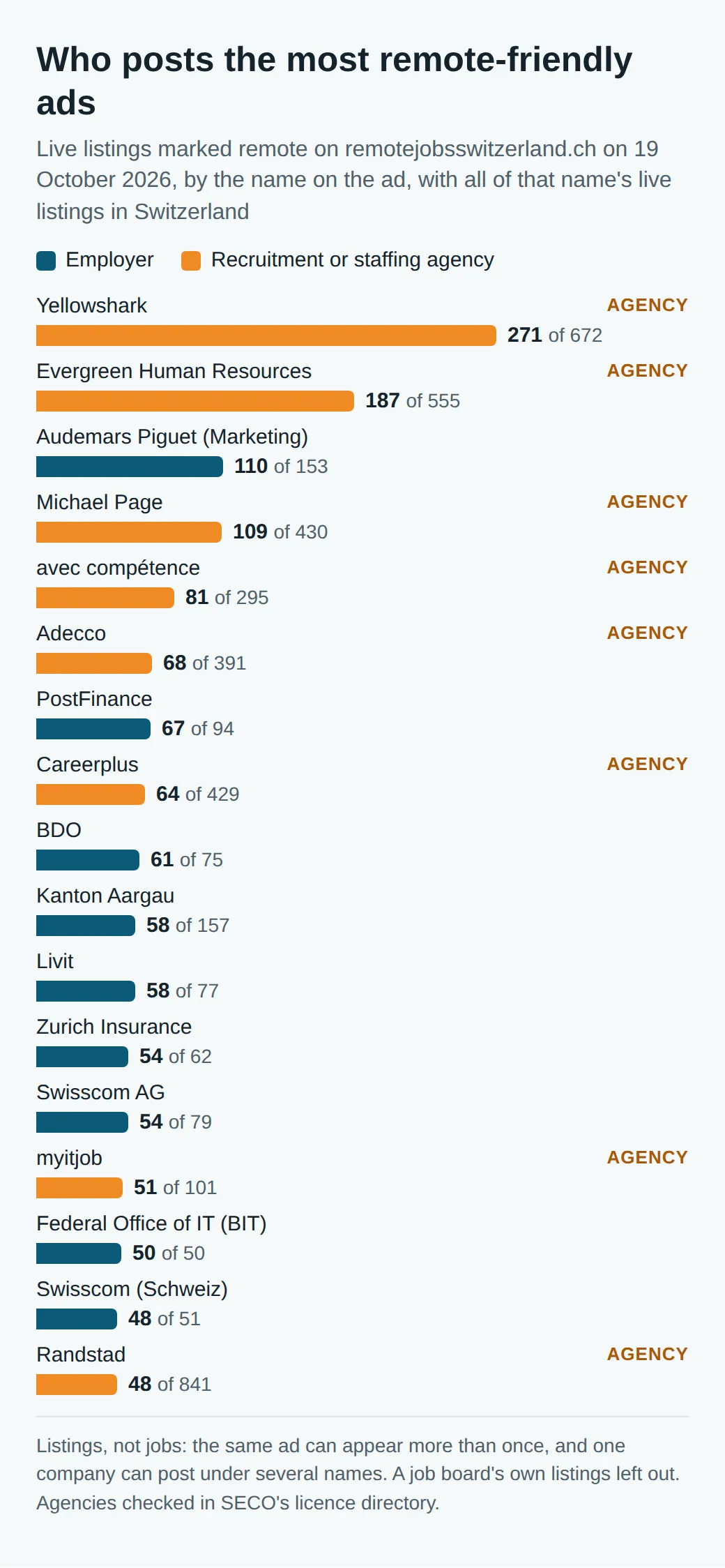
Among employers who hire for themselves, the leaders are a watchmaker, a bank, an audit firm, a property manager, a canton, an insurer, a telecoms group and a federal office. Audemars Piguet had 110 remote listings under its marketing company and 23 more under its main one. PostFinance had 67, BDO 61, Livit and Kanton Aargau 58 each. Zurich Insurance had 54 under its long legal name plus 45 as plain Zurich, and Swisscom 54 under one name plus 48 under another.
The second number in the chart matters as much as the first. It shows all of that name's live listings in Switzerland, remote or not, so you can see how much of an employer's hiring is open to home office at all. At PostFinance it was 67 of 94 listings, at BDO 61 of 75. At the Federal Office of Information Technology it was every one of its 50.
Before you read the ranking as a league table, though, two things distort it: names and duplicates. Some employers post under several names. Zurich appears as Zurich and as its long legal name, and 16 job titles show up word for word under both. The Swiss Army's cyber command posts in German, French and Italian under three names, with 39, 21 and 21 listings. Some agencies post the same ad many times over, which we come to below. So treat the counts as a guide to who is actively looking, not as a precise ranking.
Where nearly every listing is remote
The share of remote listings tells you more about an employer than the raw count. A big employer can top the chart with a small fraction of its jobs, while a smaller one may offer home office on almost everything it advertises. These were the names on our list where all or nearly all live listings carried the remote label:
| Employer | Remote listings | All listings |
|---|---|---|
| Federal Office of Information Technology (BIT) | 50 | 50 |
| Federal Office of Public Health (FOPH) | 17 | 17 |
| Generali Personenversicherung | 25 | 26 |
| Swisscom (Schweiz) AG | 48 | 51 |
| Federal Office for the Environment | 27 | 29 |
| LGT Capital Partners | 23 | 25 |
| Zurich Insurance | 54 | 62 |
The environment office posts under its French and German names; the table shows the French one, and the German one had 23 remote listings of 30. The federal administration stands out. Several federal offices and the army staff had every listing, or all but a few, marked remote. The IT office and the environment office put it into the place of work itself: "Zollikofen, Switzerland (and home office)" in one, "Ittigen, Switzerland (and home office)" in the other.
At the other end, some large names advertise a lot but offer home office on a small slice. Randstad had 48 remote listings out of 841, Manpower 21 of 395, the University Hospital Zurich 16 of 224 and the City of Zurich 41 of 419. Hospitals, city services and temporary staffing hire many people for work that can only be done on site. If you want home office at one of these, search for office roles in IT, finance or administration rather than browsing the employer as a whole.
Agencies: 42 percent of the top listings
Twenty of the 79 names are recruitment or staffing agencies, and together they posted 1,180 of the 2,812 remote listings, 42 percent. We checked each of them in the directory of licensed agencies that the State Secretariat for Economic Affairs (SECO) keeps with the cantons. All 20 were there. SECO's page on the directory explains the two kinds of licence: placement, where the agency finds you a job with its client, and staff leasing, where the agency employs you and hires you out.
That difference matters to you. With a placement, you sign with the client company and the agency steps out. With staff leasing, the agency is your employer, and your home office arrangement depends on both the agency's contract and the client's rules. Most of the agencies on our list hold both licences. avec compétence holds only the staff leasing one, while myitjob, Wetzel Personalberatung and p4b hold only the placement licence.
Agencies are less remote than their volume suggests. Only 21 percent of the agencies' live listings in Switzerland were marked remote, against 40 percent for the employers on the same list. Their ads were more precise, though: 41 of the 156 agency ads we read named a share or a number of days, against 60 of 380 employer ads.
The other thing to know is repetition. Evergreen Human Resources had 187 live remote listings, but only 11 different title lines among them. "Sr. Software Engineer Java" alone appeared 66 times, in two spellings, and "Mandate Manager Fiduciary" 56 times. That's one or two real searches posted again and again, so 187 listings is not 187 chances.
Swiss law gives you some footing here. The federal law on job placement and staff leasing (the Arbeitsvermittlungsgesetz, in German) requires a placement agency's ads to give its name and address and to "match the actual conditions", and a staff leasing agency must say clearly in the ad that you'll be hired for staff leasing. An agency may also use your data only as far as the placement needs it. So if a placement agency's ad promises home office that the job doesn't have, it is the ad that breaks the rules.
A last point before you send your CV to an agency: some employers refuse agency applications. Of the 40 Swisscom ads we read, 38 say Swisscom does not accept CVs from agencies, and 6 of the 20 Canton of Zurich ads say applications through recruitment agencies or personnel services will not be considered. If you want one of those jobs, apply to the employer directly. Our post on fake remote job offers covers what a genuine agency may charge you, which is very little.
What "remote" means in the ads
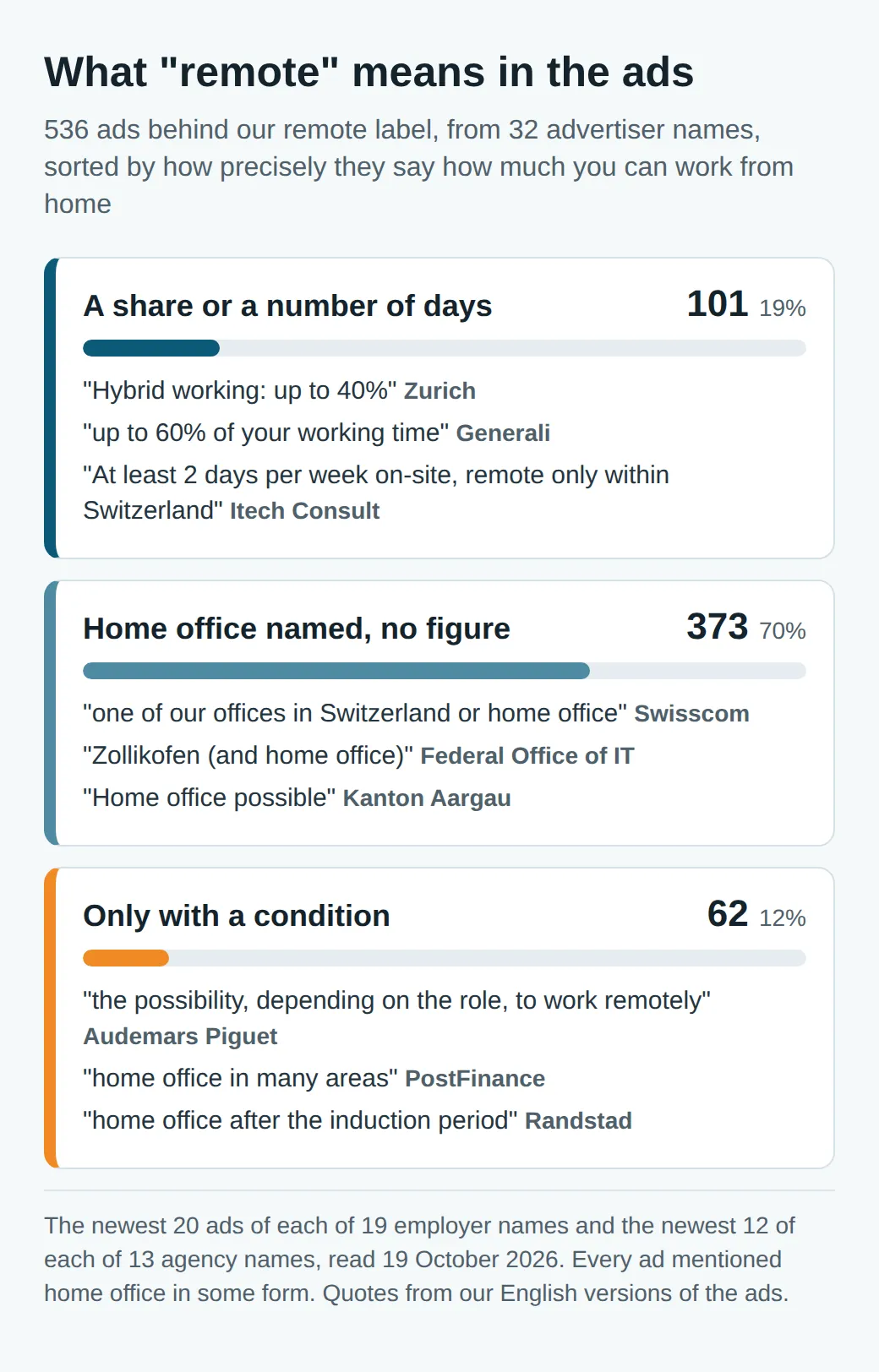
In most ads, remote means home office is possible, not how much of it. We read the newest 20 ads of 20 employer names and the newest 12 of 13 agency names, 556 ads in all. We set Implenia's 20 aside because many of its ads carried another company's text, which leaves 536 ads from 32 names. Then we sorted them by how precisely they say how much of your week can be spent at home.
A number in writing: one ad in five
Only 101 of the 536 ads named a share or a number of days. They are the easiest to judge, and a few employers do it in every ad. Zurich puts a line in its "good to know" box: "Hybrides Arbeiten: bis zu 40%", so up to two days a week at home on a full-time job. Generali goes further: "Je nach Pensum kannst du bis zu 60% deiner Arbeitszeit remote arbeiten", up to 60 percent of your working time depending on your workload. That was the highest figure we found. None of the 536 ads offered fully remote work.
Agencies tend to pass on the limits their clients set. One Itech Consult ad reads "Mindestens 2 Tage pro Woche vor Ort, Remote nur innerhalb der Schweiz": at least two days a week on site, and remote only from inside Switzerland. Half of Itech's ads carry that last clause, and it has a reason: working from another country brings social security and tax rules into play, which we explain in our post on working abroad for a Swiss employer.
Home office named, but no figure
Seven in ten ads, 373 of 536, say home office exists and stop there. Swisscom's ads say you can work "in one of our offices in Switzerland or from your home office". The federal offices write it next to the town. Kanton Aargau puts "home office possible" in the job's key facts, Livit "Home- / Mobile Office", and AXA "Smart Working". Hirslanden puts "Home-Office" in the place of work line, beside the office address.
These ads are honest but incomplete. An employer's own rules usually decide how much, and they rarely appear in the ad. The Canton of Zurich, which had 29 remote listings with us, publishes its rules in a leaflet on mobile work. It treats mobile work as voluntary, to be agreed with your supervisor, and it does not recommend doing your whole workload that way. So "home office possible" at the canton usually means part of the week, agreed with your boss.
"Depending on the role"
The vaguest group, 62 ads, makes the offer conditional without saying exactly on what. Audemars Piguet's ads in French read "La possibilité selon la fonction de travailler à distance", the possibility to work remotely depending on the role. The same line appears in ads for an angleur, who finishes watch parts by hand, a senior programmer setter and a stock team leader, which are hard to picture at a kitchen table. PostFinance offers "Homeoffice in vielen Bereichen", home office in many areas, alongside coworking spaces in Bern and Zurich.
A few agency ads belong here too: home office "after the induction period" in one Randstad ad, "to a certain extent" in a Careerplus one. These employers do offer home office somewhere. The ad just doesn't tell you whether this job is one of the places, or when. That's exactly the question to ask in the first call.
Every one of the 536 ads mentioned home office or remote work in some form, so the label itself held up. The real gap is the 81 percent that say home office without saying how much.
How to read a remote ad before you apply
Start with the place of work line and the benefits list. They are where employers state the share, if they state it at all. Look for a percentage, a number of days, or a limit like "only within Switzerland". If you find one, you can compare the job with others straight away. If you don't, the ad is telling you that home office exists, not that you'll get it.
Then check who is posting. If the name is an agency, look it up in SECO's directory, and look at whether the same title appears dozens of times. A placement ends with a contract with the client, and staff leasing makes the agency your employer, so ask which one it is.
Ask about the share in the first conversation, not after the offer. A short question works:
Your ad mentions home office. For this role, how many days a week does the team usually work from home, and is that written into the contract or a policy?
Get the answer in writing before you sign, in the contract or an annex. If you'll work from home most of the week, your employer may also have to share the cost of your workspace, which our post on home office allowances explains. And if you'd rather not work from your kitchen at all, our coworking price comparison shows what a desk costs.
How we counted
A listing carries our remote label when it is marked as open to remote work or home office. We read the company pages on remotejobsswitzerland.ch on 19 October 2026 for the remote counts, and the same pages on our general board for all live listings in Switzerland. The ad sample is the newest ads per name on that day. These counts move every day, as ads expire and new ones arrive, and they cover only employers and agencies that advertise with us. They say nothing about firms that never post a job.
Where to start
If you want home office in writing, the most reliable places in our count were two insurers and the federal administration. Zurich and Generali state a share in their ads, and the federal offices advertise nearly every job with home office. Swisscom, PostFinance and BDO offer it widely, but you'll have to ask how much. Agencies bring a lot of volume, so check the licence, count the duplicates and apply directly where the employer asks you to.
Common questions
- Is there a Swiss company where I can work fully remote?
- Not among the employers we checked. None of the 536 ads we read offered fully remote work, and the highest share in writing was 60 percent at Generali. Fully remote roles do exist, but they are rare enough that you should ask about them directly rather than expect them.
- Do I pay anything when a recruitment agency places me?
- Usually not, because most agencies are paid by the employer. The law allows an agency to charge you a small registration fee and a commission, but the commission is due only once you have signed a job contract, and both are capped by a federal ordinance. An agency that wants money before it has done anything is a warning sign.
- Can I ask for more home office after I start?
- You can ask, but in practice your employer decides unless your contract or an internal policy gives you a share. That is why the figure belongs in the contract or a written annex before you sign. A promise in an interview is hard to rely on later.
- Why does one employer appear under several names on job boards?
- Large groups post through different companies of the group, and some publish the same ad in German, French and Italian under a name in each language. The Swiss Army's cyber command, for example, posts as Kommando Cyber, Commandement Cyber and Comando Ciber. Count the jobs, not the names.
More posts
All posts
Digital nomad visa in Switzerland: the legal routes in 2026
Switzerland has no digital nomad visa. What the law allows instead: the 90/180 rule, the 8-day limit, EU residence without a job, quotas and staff leasing.

Right to work from home in Switzerland: the rules in 2026
Switzerland gives you no legal right to work from home. When your employer can order you back, when it needs your consent or notice, and what protects you.

Working for a foreign company from Switzerland in 2026
Living in Switzerland with an employer abroad: the ANobAG status, why you may pay 12.8% in contributions, tax with no withholding, pension and permit rules.