Digital nomad visa in Switzerland: the legal routes in 2026

The short answer
Switzerland has no digital nomad visa, and no permit with that purpose exists in its immigration law. What you can do depends on your passport. EU and EFTA citizens may live here and keep working for an employer abroad if they have enough money and health insurance. Everyone else can visit for up to 90 days in 180, but remote work during that visit is only clearly allowed on up to eight days a year.
Beyond that, the routes are the ordinary ones: a Swiss job, a business of your own, or a permit for another reason such as study or family. Most of the pages that rank for this question come from eSIM sellers and payment apps. Some describe a nomad visa that might exist one day, with an income threshold that one of them later presents as a requirement. A claim also circulates about a special nomad L permit from 1 July 2026 with a CHF 5,000 income floor. We found no such category in the Foreign Nationals and Integration Act (AIG), in its ordinance on admission as in force since 1 October 2026 (VZAE), or on the pages of the State Secretariat for Migration (SEM). So we went to those texts directly.
Is there a digital nomad visa for Switzerland?
There isn't. A Swiss residence permit is always granted for a purpose, the law says so for the short-stay L permit and the B permit alike (AIG articles 32 and 33), and remote work for a company abroad is not one of the purposes the law lists. Neither the act nor its ordinance on admission mentions telework, home office or nomads at all.
What does exist is a set of rules that were written for other situations and now decide yours. Which of them applies turns on two questions: are you an EU or EFTA citizen, and does your work touch the Swiss labour market, meaning Swiss clients, a Swiss employer or local work? Here is how the main routes compare.
| Route | EU and EFTA citizens | Everyone else |
|---|---|---|
| Visit and work remotely | Up to 3 months, no permit | 8 days a year are safe, more is a grey zone |
| Live here, employer abroad | Permit as a non-employed person | Only on a permit for study or family |
| Freelance | Self-employed permit, at least 5 years | Only if it serves the Swiss economy |
| Swiss job or employer of record | Normal L or B permit | Quota, priority rules, qualified staff only |
The first row is the one most guides get wrong, so we start there.
Can you work remotely on a tourist stay?
If you're not an EU or EFTA citizen, only for a few days. Swiss law lets you stay up to three months without a permit only for a stay without gainful activity (AIG article 10). The next article says that anyone who wants to work in Switzerland needs a permit, however short the stay (article 11).
The ordinance then defines work broadly. Under VZAE article 1a, employed work is any activity for an employer based in Switzerland or abroad, whether the salary is paid here or abroad, and even if it lasts only hours or days. Taken at its word, that covers a laptop in a holiday flat in Lucerne, answering to a manager in Toronto.
There's one written safe harbour. VZAE article 14 says people who work temporarily in Switzerland for a foreign employer need a permit only once the work lasts longer than eight days in a calendar year. In construction, hospitality, cleaning, security and a few other sectors the permit is needed from the first day, but those aren't laptop jobs.
Past those eight days, the official texts leave a gap. The SEM's circular of 5 April 2022 to the cantons says that for non-EU nationals, home office work that affects the Swiss labour market always needs a permit, whatever its length. It doesn't say what happens to work that has no such effect during a short visit. In practice, the industry association Swissmem writes that foreign staff on foreign contracts need no work permit as long as their work doesn't touch the Swiss labour market in any form, for example by serving Swiss clients. That is practice, not a rule you can invoke. The decision belongs to the cantonal labour market office, which decides whether an activity counts as work and passes doubtful cases to the SEM (VZAE article 4).
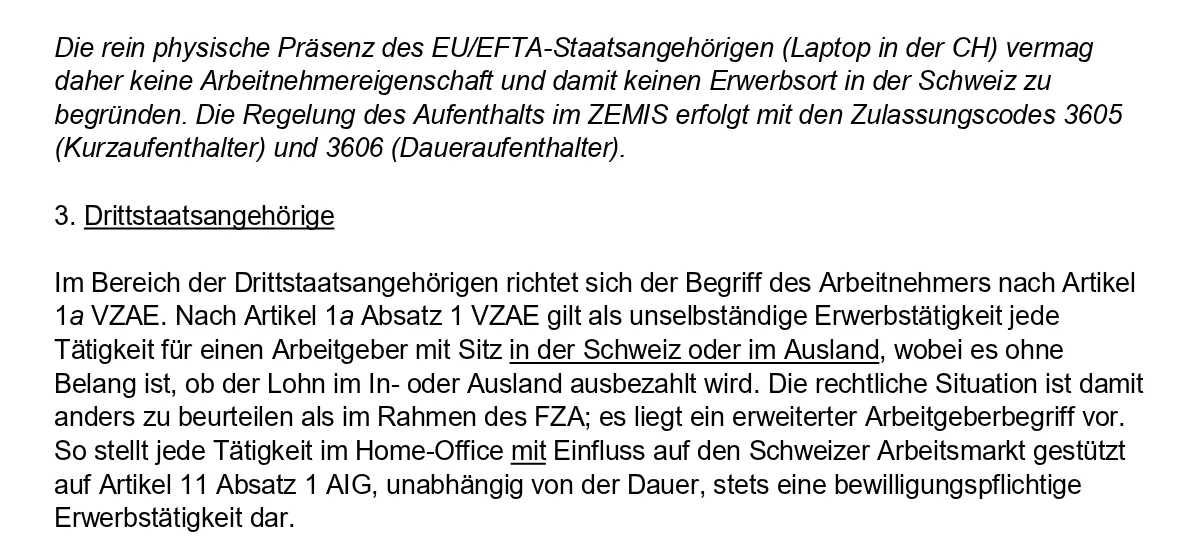
For EU and EFTA citizens the same circular is far more relaxed. Under the free movement agreement, only an employer based in Switzerland makes you a worker here, so the SEM says the purely physical presence of an EU national with a laptop creates no place of work in Switzerland. You are treated as a non-employed person, and for visa-free stays of up to three months, twice a year, you don't even have to prove that you have enough money. The condition is the same as everywhere in this article: no Swiss clients, no work aimed at the local market.
Counting the 90 days, and why Lisbon counts
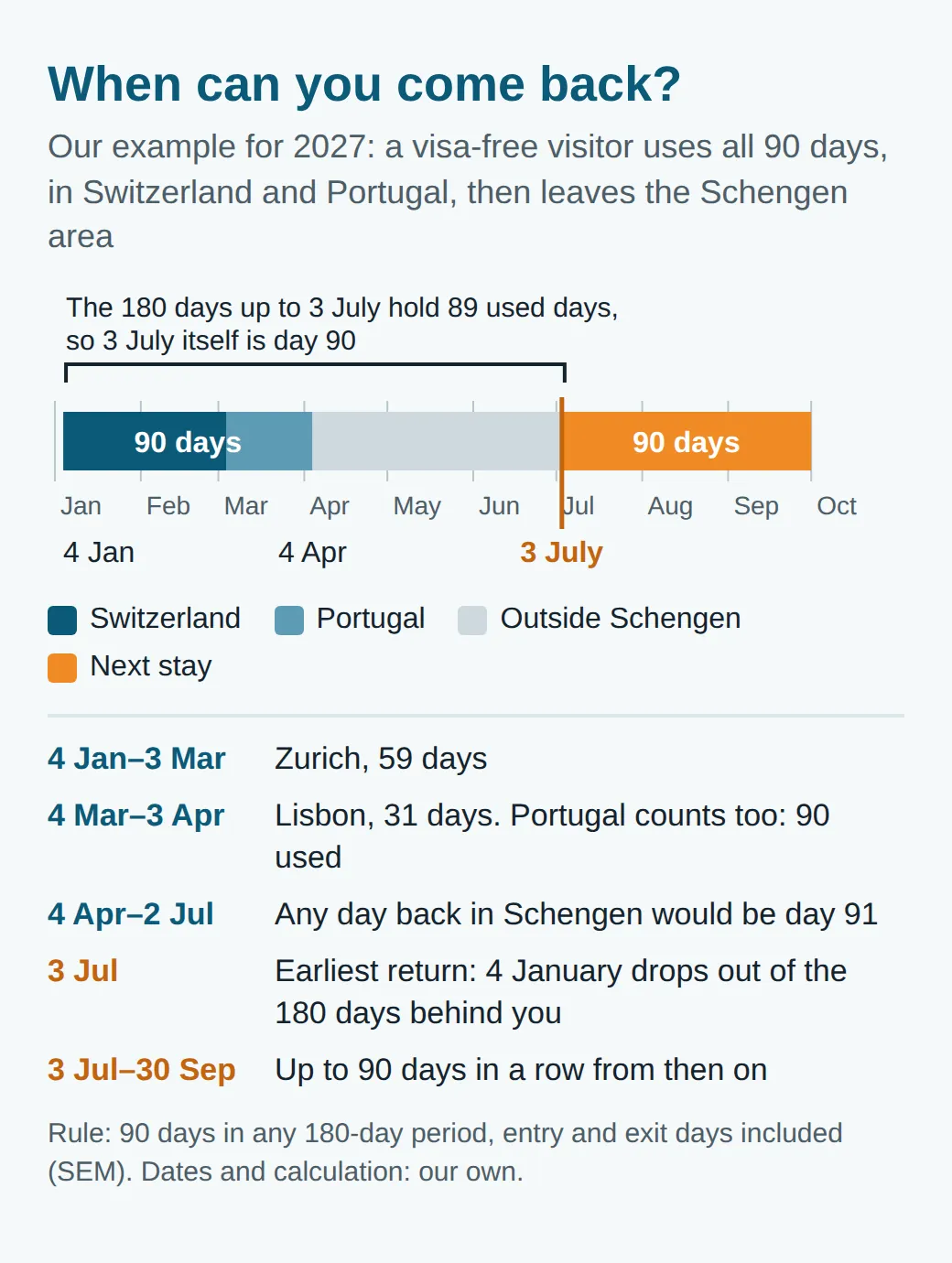
If you're not an EU or EFTA citizen, your visa-free days are counted across the whole Schengen area, not per country. The SEM's page on the length of stay sets out the rule: at most 90 days within any 180-day period, the day you enter and the day you leave both count, and the 180 days roll. On every day of your stay, you look back over the previous 180 days and add up what you've used.
That rolling window is what catches people out. A month in Zurich, a month in Lisbon and a few weeks in the Dolomites are one stay as far as the count is concerned. And the count is now hard to blur. The Entry/Exit System has been introduced step by step across the Schengen area since 12 October 2025, and the SEM's page on it says it registers every entry and exit of non-EU travellers, calculates the length of stay automatically and replaces passport stamps.
EU and EFTA citizens are not bound by the 90/180 count. For them, the limit that matters is three months, after which a stay needs a permit.
A second count runs alongside, and it concerns tax. Under the federal tax act, you become taxable in Switzerland as a resident if you stay here for at least 30 days and work, or 90 days without working, even with short breaks. A tax treaty between Switzerland and your home country may still give the right to tax your salary to the other country, but a long working stay is no longer invisible to the Swiss tax office. That's one more reason a stay longer than a holiday needs a proper status, which is where the EU route comes in.
EU and EFTA citizens: living here as a non-employed person
This is the closest thing Switzerland has to a nomad permit, and it is open only to EU and EFTA citizens. Under Annex I, article 24 of the free movement agreement, a citizen who doesn't work in Switzerland gets a residence permit valid for at least five years, provided they have enough money not to need social assistance and health insurance that covers all risks. The SEM's page on the B EU/EFTA permit confirms the five years and that the permit can be renewed for five more.
Working remotely for a company abroad fits this category. The SEM's circular says such employees are treated as non-employed, as long as they have no direct link to the Swiss labour market and no client contact in Switzerland, and that the income from the employer abroad counts towards the money you must show. There's no fixed amount. The SEM's directives on free movement say your means are enough if a Swiss citizen in your situation couldn't claim social assistance, measured against the guidelines of the Swiss Conference for Social Assistance (SKOS). Non-employed people are outside the quotas, and the first permit normally runs five years. It can be withdrawn or not renewed if the money or the insurance runs out.
In practice, you register with your commune within 14 days of arrival, as the SEM's free movement FAQ explains, and you take out Swiss basic health insurance within three months of moving here (Health Insurance Act, article 3). The paperwork that follows is the part people underestimate. Your employer abroad usually has no Swiss payroll, so social security contributions and tax often land with you. We cover that in our guide to working for a foreign employer from Switzerland.
The status ends the moment your work turns local. If you start serving Swiss clients, the SEM treats you as a posted worker, or as a cross-border service provider if you work for yourself. Those are other rules, and they lead to freelancing.
Freelancers: self-employment
For EU and EFTA citizens, setting up as self-employed is a right, not a favour. Annex I, article 12 of the free movement agreement gives a permit valid for at least five years to anyone who shows they are established, or will establish themselves, as self-employed here. The SEM's FAQ adds that you register within 14 days and may not start until you've handed in the documents the canton asks for. If all your clients are abroad and you serve nobody here, the SEM circular says you're treated like the remote employee above, as a non-employed person who must show sufficient means.
For everyone else, self-employment is not a nomad route. AIG article 19 admits a self-employed person only if it is in the interest of the Swiss economy as a whole, the financial and operational conditions are met, and the business gives you a sufficient livelihood of your own, and the quotas still apply. The SEM's working FAQ says you must show a lasting positive effect on the Swiss labour market and hand in a business plan, financial documents, the company's articles and a commercial register extract. A one-person consultancy billing clients in New York doesn't pass that test.
A Swiss employer, or an employer of record
The route that works for every passport is a job with a Swiss employer, and for non-EU citizens it is also the narrowest. EU and EFTA citizens just need the contract: the SEM issues a five-year B permit for a contract of at least twelve months or an open-ended one, and remote days with a Swiss employer are a matter for your contract, not your permit.
For everyone else, the Swiss employer has to apply, not you (AIG article 11), and three filters apply. The employer must show that no suitable person could be found in Switzerland or the EU and EFTA (article 21). Only managers, specialists and other qualified workers are admitted (article 23), which the SEM's page for non-EU nationals translates as a degree plus several years of work experience. And the permits are capped.
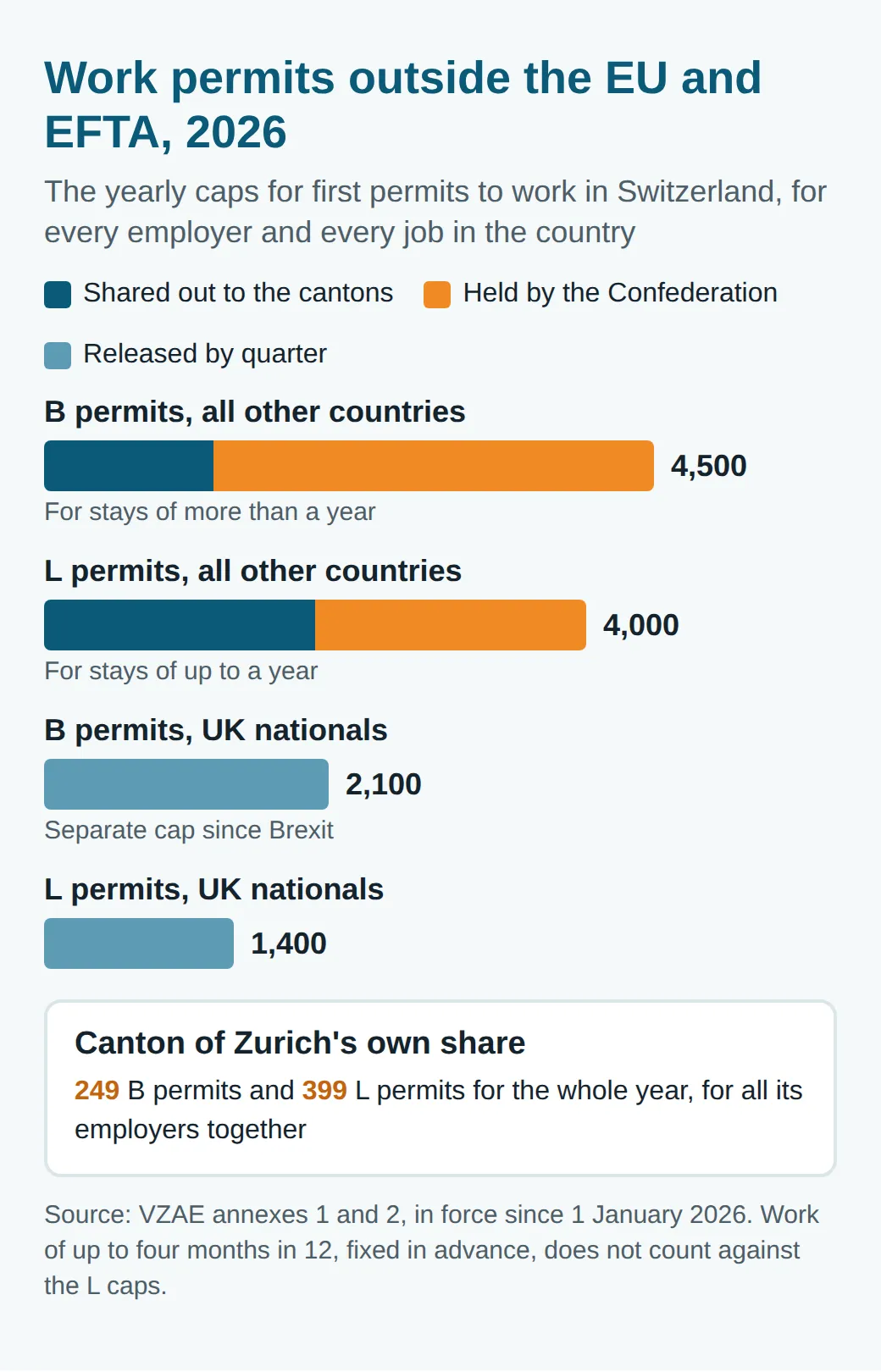
The caps for 2026 are 8,500 permits for qualified workers from all countries outside the EU and EFTA, with the UK counted separately: 4,500 B permits and 4,000 L permits, set out in the annexes of the VZAE. The canton of Zurich's own share is 249 B permits for the whole year, for all its employers. The Federal Council's press release of 19 November 2025 said the cantons had used about 52 percent of the third-country quotas by the end of September 2025, so in 2025 the cap was not what stopped most cases. The tests before it were. The figures for 2027 were still under consultation in October 2026; the Federal Council usually sets them late in the year, for the year that follows.
Fully remote roles face an extra question. The SEM's circular tells the cantons to look closely at whether admitting a newcomer who will work entirely from home is in the economic interest, and it reports a 2021 survey in which no canton had yet granted a work permit to a newly arriving non-EU national for pure home office. If you want the job to be remote, it helps to start in a role where the office matters.
Why an employer of record rarely helps non-EU citizens
An employer of record is a Swiss company that employs you on paper while you work for another firm. Swiss law calls this staff leasing. A leasing company needs a licence from its canton, a second one from SECO to lease staff to clients abroad, and leasing staff from abroad into Switzerland is not allowed at all (Recruitment Act, article 12). For EU and EFTA citizens, a licensed employer of record works like any Swiss employer.
For non-EU citizens it usually doesn't. A leasing company may only hire foreign nationals who are already allowed to work and to change jobs (article 21). The SEM's directives, section 4.8.4.3, say that as a rule no first work permit is granted to a newly arriving third-country national for staff leasing. The exception is a specific, time-limited project with a proven special interest, and even then only on a short-term L permit. An offer that promises a nomad an employer of record and a Swiss permit in one package deserves the scepticism our guide to fake remote job offers recommends.
Routes that look promising but don't fit
Two routes appear in many lists and don't work for someone who wants to keep working. The first is lump-sum taxation, often called a golden route for the wealthy. The federal tax act allows it only for people who do no gainful work in Switzerland, with a minimum taxable base of CHF 435,000 a year at federal level. Working remotely from a Swiss flat is gainful work in Switzerland, so it rules you out. The residence permit for important fiscal interests behind it doesn't allow work either (VZAE article 32).
The second is coming as a student or a family member and working remotely on the side. The SEM's circular says these are, in fact, the only permits on which a non-EU newcomer working from home for an employer abroad can be admitted. But the permit is granted for the study or the family, so you have to meet those conditions on their own, and any work on top follows that permit's rules.
What to do next
Start with your passport. If you're an EU or EFTA citizen, plan the non-employed route: proof of income, health insurance, registration within 14 days and, before you move, a clear view of the contributions your employer abroad won't pay. If you'll want a desk outside your flat, our guide to coworking prices covers what a fixed desk costs.
If you're not, there are two honest options: visits within the 90 days in 180 with work kept to the eight days the ordinance allows, or a Swiss job that comes with its own permit. For anything in between, ask the canton before you travel. Write to the migration office of the canton where you'll stay and ask for an answer in writing:
I am a [nationality] citizen employed by [company] in [country], which has no branch or clients in Switzerland. I plan to stay in [town] from [date] to [date] and work remotely for my employer during that time. Does this count as gainful activity that needs a permit under article 11 AIG and article 1a VZAE, and if so, which permit would apply?
If the Swiss job is the route you choose, our board lists employers hiring for remote-friendly roles, software engineering among them.
A written answer from the canton is worth more than any blog post, ours included. Ask for it before you book a flat, not after the first month.
Common questions
- Does the new Entry/Exit System change what I may do?
- No, it changes how precisely your days are counted. The SEM says the EES registers every entry and exit of non-EU and non-EFTA travellers, works out the length of stay automatically and replaces passport stamps. The 90 days in 180 and the rules on work in this article stay as they are.
- Can I come as a tourist and apply for a permit once I'm here?
- Usually not. If you entered for a temporary stay and then apply for a long-term permit, the Foreign Nationals Act says you wait for the decision abroad. The canton may let you stay during the procedure only if the conditions are clearly met. If you want to change the purpose of your stay, you must register at least 14 days before your visa-free stay ends.
- Is there a minimum income for EU citizens who live here without a Swiss job?
- There is no fixed figure. Your means count as sufficient if a Swiss citizen in the same situation could not claim social assistance, and the cantons measure that against the guidelines of the Swiss Conference for Social Assistance (SKOS). A salary from your employer abroad counts towards it.
- I'm British. Which rules apply to me?
- Since Brexit, UK citizens who arrive now are no longer covered by the free movement agreement. You fall under the Schengen 90 days in 180, and a Swiss job needs a permit from a separate UK quota: 2,100 B permits and 1,400 L permits for 2026, released quarter by quarter.
- What happens if I work without a permit?
- Working without the permit you need is a criminal offence under article 115 of the Foreign Nationals Act. The penalty is a custodial sentence of up to one year or a monetary penalty, and a fine if you acted negligently.
More posts
All posts
Work remotely from abroad for a Swiss employer: 2026 rules
Working abroad for a Swiss employer in 2026: the 25% and 50% social security limits, the A1, tax in France, Italy and Germany, permits and employer risk.

Right to work from home in Switzerland: the rules in 2026
Switzerland gives you no legal right to work from home. When your employer can order you back, when it needs your consent or notice, and what protects you.

Remote companies in Switzerland 2026: what the ads promise
Which Swiss employers post the most remote-friendly jobs, what 536 of their ads promise about home office, and the 42% posted by agencies.