Right to work from home in Switzerland: the rules in 2026

The short answer
No. Swiss law gives you no right to work from home, and parliament isn't about to create one. Whether your employer can order you back depends on where your home office days come from: if they're only a policy or a habit, an instruction is usually enough; if they're in your contract, the employer needs your consent or must give notice.
That second case is where most people lose ground without noticing. The pandemic rules that pushed everyone home ended long ago, and what decides your case today is ordinary contract law: the Code of Obligations, the Federal Council's report on the legal side of telework, two court rulings we walk through below, and a bill in parliament that keeps the same starting point.
Is there a right to work from home in Switzerland?
There isn't, for anyone in a private job. No law says so, and the Federal Council put it in one line in its 2016 report on telework: "Für die Beschäftigten besteht kein Anspruch auf Telearbeit", employees have no claim to telework. It needs the employer's consent.
The Labour Act doesn't mention home office either. SECO, the federal labour authority, notes on its home office page that the Act's rules on health and working hours still apply wherever you work. Its home office brochure adds that the legal framework leaves employers a lot of room in how they organise it. That room is the whole story.
None of this means home office is rare. In its opinion of May 2025, the Federal Council cites the Swiss Labour Force Survey: in 2023, 33 percent of the roughly 2.97 million employees covered by the Labour Act worked from home at least part of the time. Each of those arrangements rests on something: a contract, an email, a policy or a habit. Which one it is decides the next question.
Where your home office comes from decides everything
The law starts from your contract. The Code of Obligations has no rule on where you work, so the general rule on the place of performance applies: it's whatever the parties agreed, expressly or by their conduct (art. 74). The Federal Council's report draws the consequence: your place of work comes first from the employment contract, and home office can come from that contract or from a later agreement that changes it.
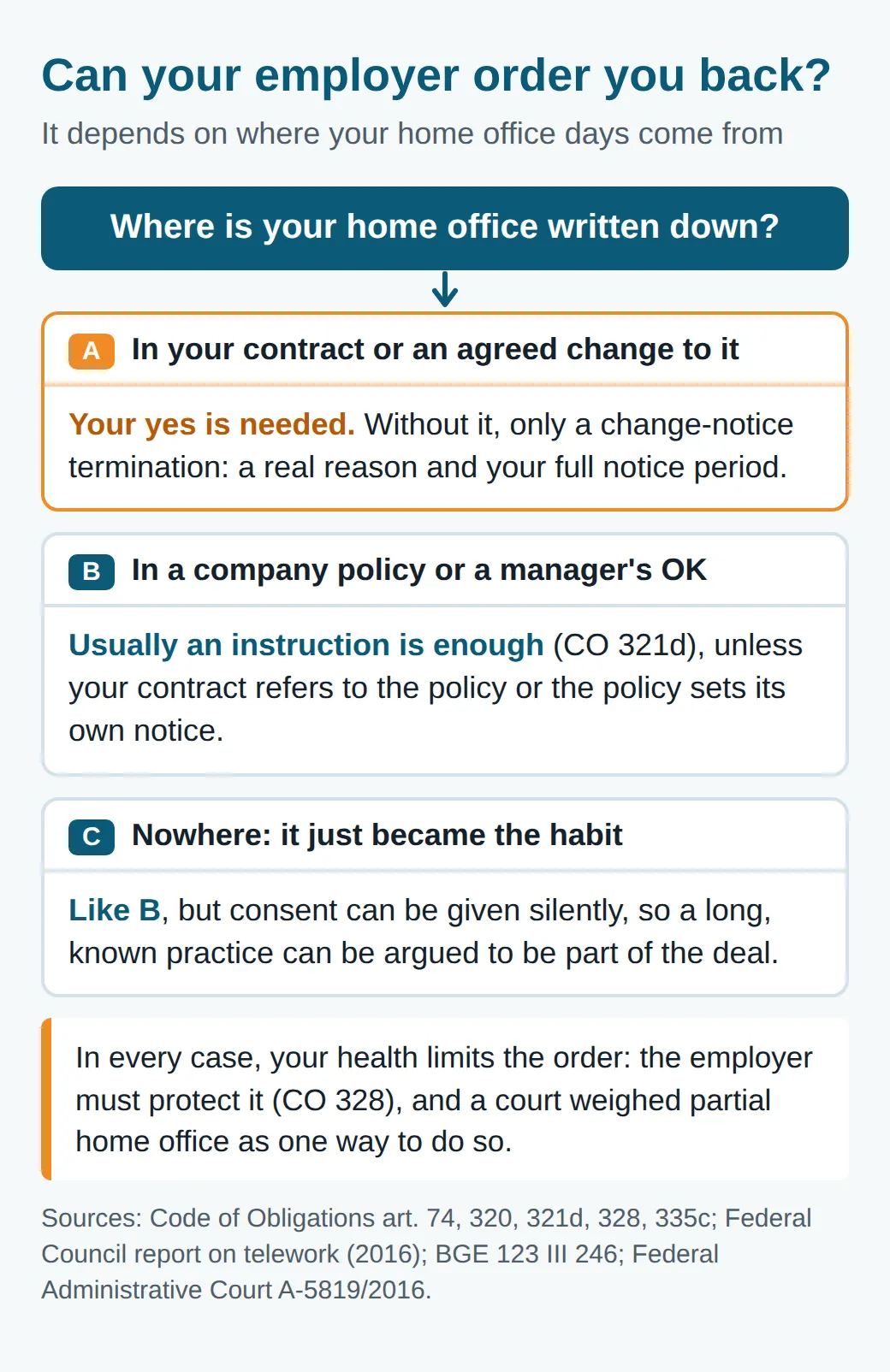
In practice your home office days rest on one of four things, and they don't carry the same weight.
- A clause in your contract, such as "two days a week from home" or a role hired as remote.
- A later agreement, in writing or by email. Swiss employment contracts need no special form (art. 320), so an exchange in which both sides agree on fixed days can change your contract.
- A company policy, a directive that sets out who may work from home and how much.
- Tolerance, where you simply started working from home and nobody objected.
The first two bind your employer. The last two usually don't, with one catch. The Federal Council's report adds that consent to telework can be given silently: if your employer knows you work from home and doesn't react, that consent can be held against it. So a long, open practice can be argued to have become part of your contract. Whether that argument holds depends on the facts, so don't build on it alone.
So before you react to a return-to-office email, find out which of these you have. Your contract, any annex, emails with your manager and the policy itself are the documents that matter.
When a return-to-office order holds
If your home office rests on a policy or on tolerance, your employer can usually end it with an instruction. The employer may give general rules and specific instructions on how work is done, and you must follow them in good faith (art. 321d). If your contract names the office as your place of work, sending you back there is the employer using that power, not changing the deal.
The power has limits. The Federal Council's report, citing the Federal Supreme Court, says instructions must meet a business need, relate to the work, respect the contract and mandatory law, and respect your personality, which includes your health and private life (art. 328). An unlawful instruction doesn't have to be followed. A lawful one does, even if you dislike it.
The law sets no lead time for such an instruction. A policy may set one, and if your employer's own rules promise a month's warning before a change, hold it to that. If the policy is written into your contract, for example through a sentence like "the home office policy forms part of this contract", it moves closer to the first category, and a change may need your consent.
Refusing a lawful instruction is a breach of your contract. Your employer can react with a warning or with an ordinary notice, which in Swiss law needs no particular reason as long as it isn't abusive (art. 335). A dismissal without notice needs more: a reason serious enough that the employer can't be expected to continue at all, which a judge weighs case by case (art. 337). Either way, it isn't a fight worth having when the order is lawful. The fight worth having is when your home office is part of the deal.
When your employer needs your consent
If home office is in your contract or in an agreed change to it, your employer can't take it away with an instruction. It is part of what both sides promised. Changing it takes a new agreement, and if you don't agree, the employer has one tool left: a change-notice termination.
That's a notice of termination combined with an offer to continue on new terms, here without the home office days. You can accept the new terms or let the job end. The Code of Obligations doesn't name this tool, but the courts accept it within limits. The Federal Council's report sums them up: the change must be justified by objective, operational or market reasons, and it must not take effect before your notice period has run.
The case that set the rule
The leading ruling is about a pay cut, but its logic carries over to office days. In BGE 123 III 246, an employer offered an employee a new contract on 10 December 1993, with CHF 500 less per month from 1 January 1994. She didn't sign. On 28 December the employer gave her notice to 30 April 1994, offered a new contract on worse terms from 1 May, and said it would withdraw the notice if she signed the first offer by 30 December.
The Federal Supreme Court ruled on 22 April 1997 that the dismissal was abusive. A change-notice termination is not abusive as such, the court said, but it is when the notice is used as a means of pressure to push through a change that isn't objectively justified. A big change alone doesn't make a notice abusive, the court added. What did here was the timing: the employer wanted the cut at once, without waiting out the notice period, and dismissed her for insisting on her full pay in the meantime, which her contract gave her.
Translated to home office: an employer that tells you "come back full time from Monday, or you're out" is doing what that employer did. One that gives you notice, offers the new terms from the end of your notice period and has a real reason, such as a new team set-up or a role that now needs people on site, is using the tool the way the courts allow.
How long your current set-up stays
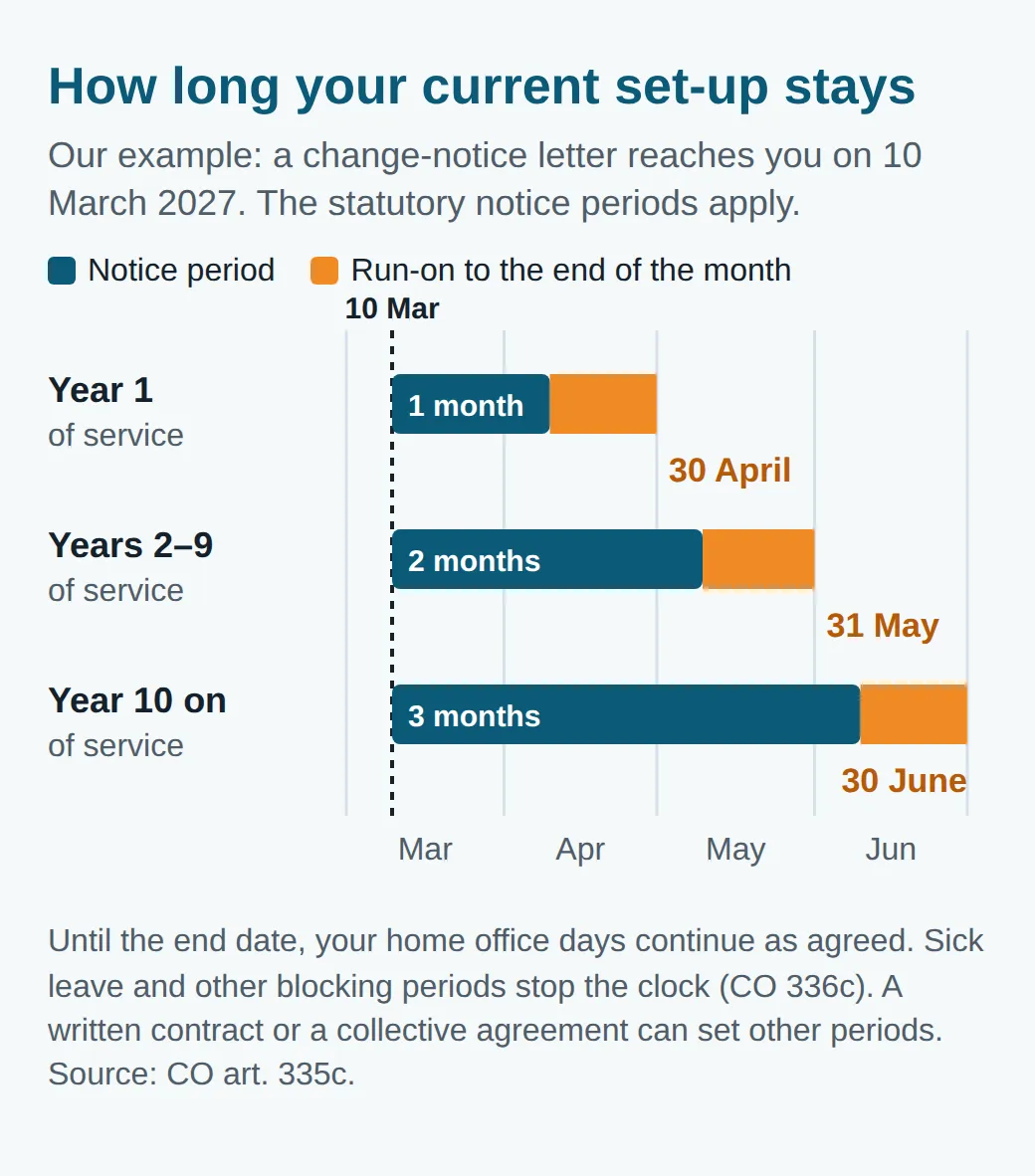
During the notice period, your old terms apply, home office days included. The statutory periods are one month in the first year of service, two months from the second to the ninth year, and three months after that, each to the end of a month (art. 335c). A written contract or a collective agreement can set other periods, so check yours.
Because a change-notice termination is a real notice, the protection periods apply to it too. If your employer gives notice while you're off sick through no fault of your own and still inside the protected period, the notice is void. That period is 30 days in the first year of service, 90 days from the second to the fifth, 180 days from the sixth (art. 336c). If you fall ill after receiving notice, the clock stops and runs on afterwards.
If you refuse the new terms
Then your job ends when the notice runs out. If you think the notice was abusive, you have two deadlines. You must object in writing to the employer before the notice period ends, and if you can't agree on continuing, you must go to court within 180 days after the job ends (art. 336b). The court can award compensation of up to six months' pay (art. 336a). It can't give you the job back. That's worth knowing before you refuse: in a private job, an abusive dismissal costs the employer money, but it still ends the job.
What protects you even without a clause
Your health is the one limit that applies whatever your contract says. The employer must take the measures needed to protect your health that are reasonable in its business (art. 328), and the Labour Act says the same in public law (art. 6). That doesn't create a right to home office, but it can make refusing a home office solution the wrong answer.
Health: a case from the federal administration
The clearest case comes from federal staff law, so it binds federal employers, not private ones. But it shows how a court weighs the duty. In case A-5819/2016, an employee of the Federal Office of Information Technology, working 80 percent, found she couldn't work in the open-plan office her floor was turned into in 2014, and from July 2015 she was off sick for long stretches. Her doctor and the federal administration's medical service said she needed a quiet office, ideally combined with part of her week at home. She had already worked two days a week from home for a month and a half under her previous supervisor. Two weeks after a new supervisor arrived, the trial was stopped, and in August 2016 she was dismissed.
The Federal Administrative Court ruled on 22 November 2017 that home office was "nicht als Anspruch", not a right, but had to be weighed in light of her health as a way to bring her back to work. Ending the trial without warning and without a fair trial period under the new supervisor was premature, and the dismissal lacked sufficient grounds. The court awarded her six months' gross salary.
For a private employer, the same duty comes from article 328. So if a doctor's certificate says you can work, but only with some days at home, give it to your employer before the return date, and ask in writing for a trial. An employer that brushes that aside without looking takes a real risk if it later dismisses you.
Pregnancy and care duties
If you're pregnant, the employer must arrange your work so that your health and your child's are not harmed (Labour Act art. 35), and you may stay away from work or leave on simple notice (art. 35a). That puts weight behind a request for home office days, though it is not a right to them.
Care duties are weaker ground. The Labour Act asks employers to pay particular attention to people raising children up to age 15 or looking after relatives who need care when they set working and rest times (art. 36). It says nothing about the place of work. The Federal Council's report notes that some legal writers see a duty to allow telework in special cases, giving the example of a mother who has to care intensively for a seriously ill child over a long period. That's a view in the literature, not settled law.
A clause in writing
The strongest protection is the one you negotiate. If home office matters to you, get it into your contract or a signed annex, with the number of days and how either side can end it. SECO's brochure suggests exactly these points for a home office agreement: whether it is voluntary or required, how many days, reachability, time recording and equipment. When you're job hunting, ask for this before you sign, not after.
What parliament is changing, and what it isn't
Parliamentary initiative 16.484 is often described as a home office law. It isn't a right to home office. It was filed by Thierry Burkart on 1 December 2016, and it asks to loosen working-time rules for people who already work from home.
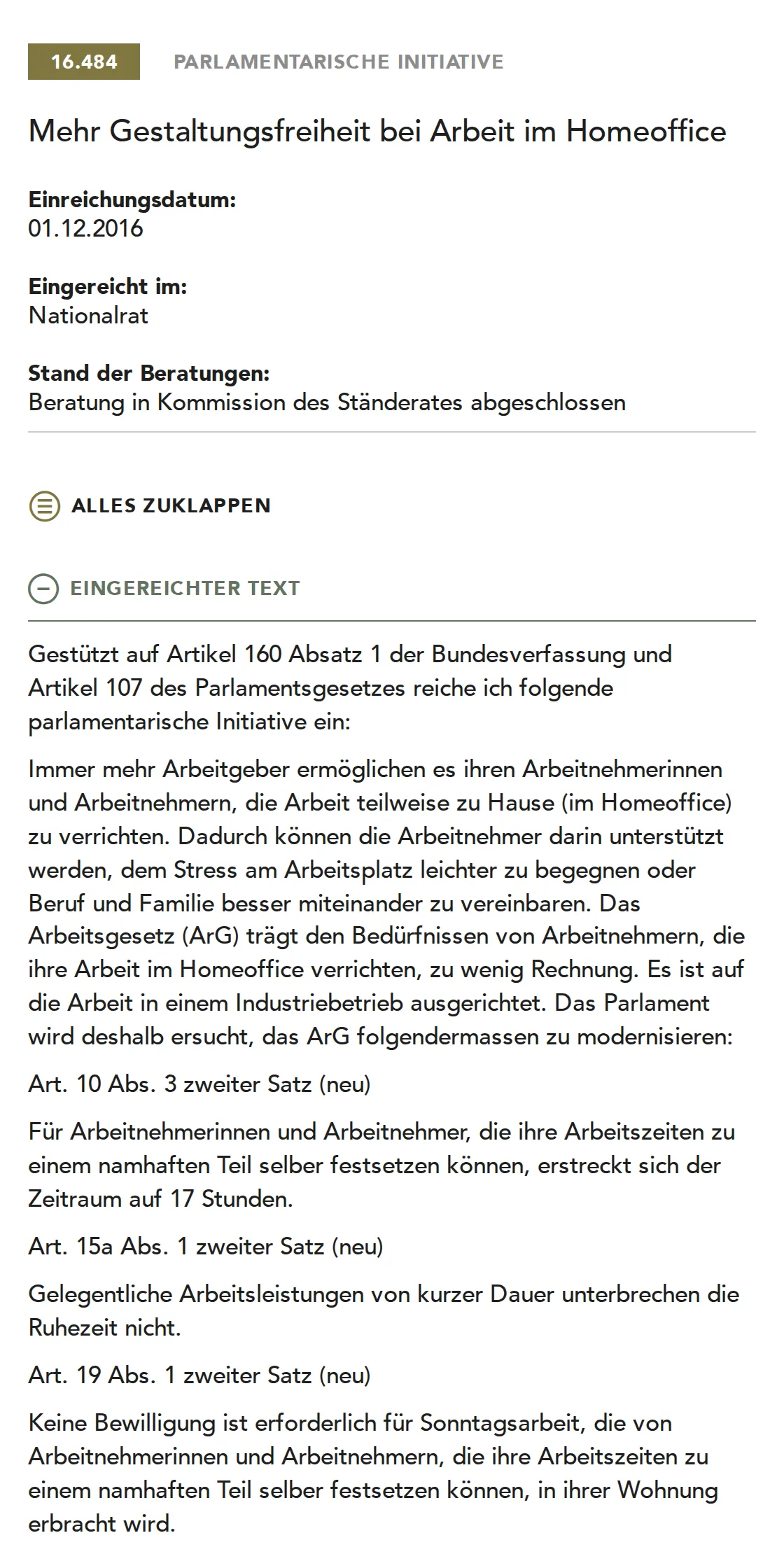
The commission report of February 2025 is explicit on our question. The telework set-up it creates is voluntary and must be agreed individually and in writing with each employee. A proposal in the same report to add a telework chapter to the Code of Obligations spells it out: "Ein einseitiges Recht einer der Parteien besteht nicht", neither side gets a one-sided right. The commission's draft would let the daily span of work stretch from 14 to 17 hours and cut minimum rest from 11 to 9 hours for people working remotely under such an agreement. In that draft, either side could end the individual telework agreement at any time with one month's notice to the end of a month, without touching the employment contract.
The National Council adopted the bill on 23 September 2025, by 119 votes to 63 with 5 abstentions, according to the parliament's record. The Federal Council wants the Code of Obligations to say that the place, share and days of telework must be agreed, and the Labour Act to say that the terms for ending telework are agreed too. On 13 October 2026, the Council of States' economic committee finished its work: it backs the Federal Council's version in the Code of Obligations rather than the separate telework chapter the National Council adopted, and wants to drop the explicit right to disconnect and the Sunday work clause. The Council of States takes up the bill in the winter session, from 30 November to 18 December 2026. The two chambers would then still have to settle their differences, so nothing changes for you yet.
Whatever version passes, the starting point stays the same: home office exists because you and your employer agree on it. The rules on working hours from home are a separate topic, and the costs of your home desk are too; for those, see whether your employer must pay for home office.
Before you answer a return-to-office email
Start with the paperwork. Find your contract, any annex, the policy in force when you agreed to home office, and every email in which days or a remote role were agreed. That tells you which category you're in.
Then ask, in writing and in a calm tone, what the order is based on. If you believe your home office is contractual, say so and ask for the change to be made properly. A short reply can do it:
Thank you for the update on office attendance. My contract annex of [date] sets two home office days a week, so I understand this as a change to my contract. I'm open to discussing it. Until we agree on something new, or the notice period under my contract has run, I'll keep to the current arrangement. Could you tell me the business reason for the change?
If your home office is only a policy, the better question is how, not whether: which days, from when, and whether a mix is possible. If your health is involved, bring the medical certificate before the date, not after. And if you think a notice is abusive, put your objection in writing before the notice period ends, because that deadline can't be fixed later.
If you'd rather work for an employer that writes remote work into the contract from day one, that's a question for the interview. Our board lists current IT operations openings below, and there are more in product and project roles.
A role that is advertised as remote and confirmed as remote in the contract is the one kind of home office no instruction can take away. That's worth more than any policy, and it costs nothing to ask for before you sign.
Common questions
- Can my employer make me work from home?
- Only in narrow cases. The Federal Council's 2016 report on telework says an employer can change your place of work on its own only for a limited time and where it has an overriding interest, for example a short-term need or an emergency. Otherwise home office has to be agreed, just like office days.
- Is an email from my manager enough to count as an agreement?
- It can be. Swiss law sets no special form for an employment contract or a change to it, so an email exchange in which you and your employer agree on fixed home office days can change your contract. Keep it. Whether a short line such as 'fine, work from home for now' is an agreement or only a permission is a question of wording and context.
- Can I be dismissed for insisting on my home office days?
- If your contract gives you those days, a dismissal because you asked for them in good faith can be abusive under the Code of Obligations. The job still ends, but a court can award up to six months' pay. You must object in writing before the notice period ends and go to court within 180 days after the job ends.
- Does my collective labour agreement change anything?
- It can. A collective agreement may set its own rules on telework, including how an arrangement is ended. When the Federal Council reviewed several agreements in 2016, those of SBB, Swisscom and Swiss Post made telework depend on the supervisor's consent, and the Swisscom one said outright that there is no right to it. Read the version that applies to you today.
- I moved far away while working remotely. Does that protect me?
- Not by itself. What matters is what you and your employer agreed. If your employer accepted in writing that you would work fully remote from your new home, that is a change to your contract and needs your consent or a change-notice termination to undo. If you moved without such an agreement, an order to come back can still hold.
More posts
All posts
Digital nomad visa in Switzerland: the legal routes in 2026
Switzerland has no digital nomad visa. What the law allows instead: the 90/180 rule, the 8-day limit, EU residence without a job, quotas and staff leasing.

Remote companies in Switzerland 2026: what the ads promise
Which Swiss employers post the most remote-friendly jobs, what 536 of their ads promise about home office, and the 42% posted by agencies.

Working for a foreign company from Switzerland in 2026
Living in Switzerland with an employer abroad: the ANobAG status, why you may pay 12.8% in contributions, tax with no withholding, pension and permit rules.