Working for a foreign company from Switzerland in 2026

If your employer is abroad
You can, and Swiss rules still apply, because you do the work here. If the company has no Swiss branch and is based outside the EU and EFTA, you are what the AHV calls an ANobAG: you register yourself and pay both halves of the social contributions, 12.8 percent of salary instead of 6.4. Tax is due here, through a normal tax return.
ANobAG stands for Arbeitnehmende ohne beitragspflichtigen Arbeitgeber, an employee whose employer owes no Swiss contributions. The status is legal and common enough that compensation offices publish their own fee scales for it, yet many of the pages that rank for this question come from payroll firms selling an employer of record service, and they skip what it costs you. This guide follows the money instead: who pays what, what you lose, which permit you need, and what to put in the contract. It draws on the AHV law and its leaflets, the Federal Social Insurance Office (BSV in German, OFAS in French), Suva, the cantonal compensation and tax offices and the State Secretariat for Migration.
One question decides who pays
Swiss social security follows the place of work. You live here and sit at your desk here, so you are insured here, wherever the payslip comes from. What changes is who pays.
Under article 12 of the AHV law, employers must pay contributions if they have a permanent place of business in Switzerland, which the law calls a Betriebsstätte, or employ staff in their household. A company abroad with no office here falls outside that rule, unless an international agreement pulls it back in. That leaves three cases, and your passport matters as much as the employer's address.
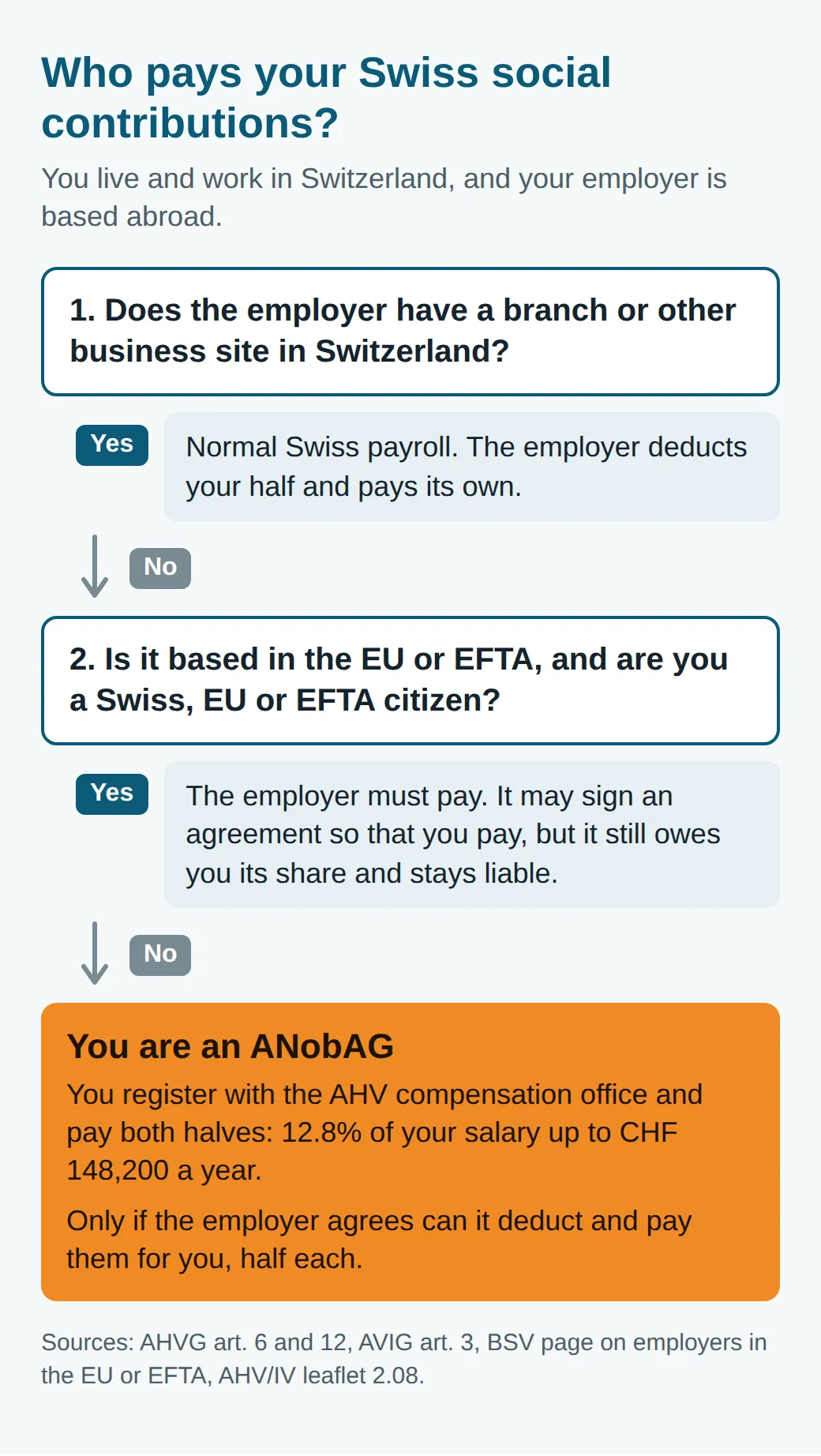
The last box is the ANobAG case. Article 6 of the AHV law says employees whose employer owes no contributions pay 8.7 percent of their salary for old-age and survivors' insurance (AHV). That is the employer's 4.35 percent and the employee's 4.35 percent added together. Disability insurance (IV) and income compensation (EO) work the same way: AHV/IV leaflet 2.01 puts the three together at 10.6 percent of salary, split equally between employer and employee, and says employees of employers that owe no contributions normally pay them themselves. The unemployment insurance law says the same for its 2.2 percent (AVIG article 3). Before getting to what that costs, the middle box deserves a closer look, because it catches people out in both directions.
If the employer is in the EU or EFTA
A company in Germany, France or another EU or EFTA state can't simply leave it to you. The BSV says such employers must pay the contributions Swiss law prescribes and, as a rule, settle them directly with the Swiss bodies. For an employee living here, the BSV's page on this case names the compensation office of your canton of residence, and adds that the employer must also provide a pension fund and accident insurance, as a Swiss employer would.
Many foreign companies don't want to run Swiss payroll, so the rules offer a shortcut: an agreement under article 21(2) of EU Regulation 987/2009, under which you take over paying the contributions. The employer still pays you its share on top of your salary, plus the administration costs, and it stays liable if the money never arrives. The BSV publishes a model agreement that also lists who gets a copy: the compensation office, the accident insurer, the pension fund and the family allowance fund. The same form covers employers in the UK under the Swiss-UK social security convention.
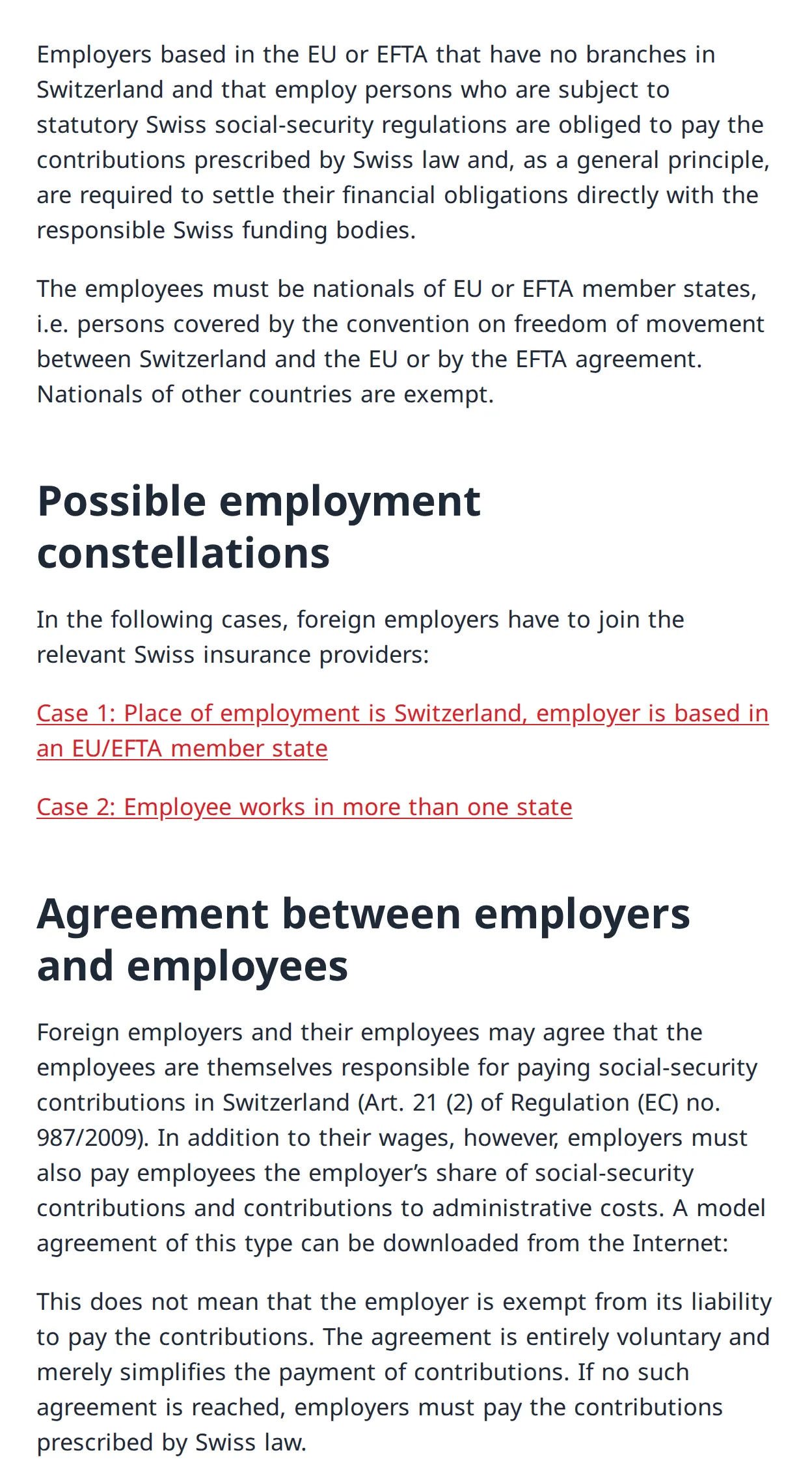
Read the second paragraph twice. The rule covers EU and EFTA nationals, and AHV/IV leaflet 10.01 applies the same coordination rules to Swiss citizens. Nationals of other countries are exempt, which means the agreement doesn't make the employer liable for them. An American working from Zurich for a company in Berlin is therefore an ANobAG, with the bill in their own name, just as if the company had no link to Europe at all.
Registering as an ANobAG
Nobody registers you. The compensation office learns about you only when you tell it, so the first step is yours. Suva's guide for ANobAG says to register with the compensation office you already belong to through other work, and otherwise with the cantonal compensation office where you live.
From then on you are handled much like a self-employed person. You pay every quarter, within ten days after the quarter ends (AHVV article 34). The office sets provisional contributions from your expected salary and settles the final amount later, with the figures from your tax assessment (AHVV article 16 applies the rules for the self-employed to ANobAG). On top, it charges a fee for its own costs as a percentage of your AHV, IV and EO contributions: SVA Zurich's 2026 scale for ANobAG runs from 5 percent for the smallest amounts down to 0.5 percent for the largest. Miss a deadline and the same leaflet says SVA Zurich charges 5 percent default interest and its highest fee rate.
Paying on time also protects your pension. For ANobAG, income is entered in your individual AHV account only as far as contributions were actually paid (AHVV article 138). A year you never declared is a hole in your future pension, not just a debt.
There is one way out of doing it all yourself. Article 6(2) of the AHV law lets the contributions be collected the normal way, deducted from your pay, if the employer agrees. Employer and employee then pay 4.35 percent of AHV each, like any Swiss payroll. It costs the employer its half, which is exactly why it's worth asking for.
What it costs: 12.8 percent, not 6.4
Paying both halves doubles your bill. Leaflet 2.08 puts AHV, IV, EO and unemployment insurance together at 12.8 percent of salary up to CHF 148,200 a year, and 10.6 percent on anything above, because no unemployment contribution is due on that part. A usual employee pays half of that and the employer the other half.
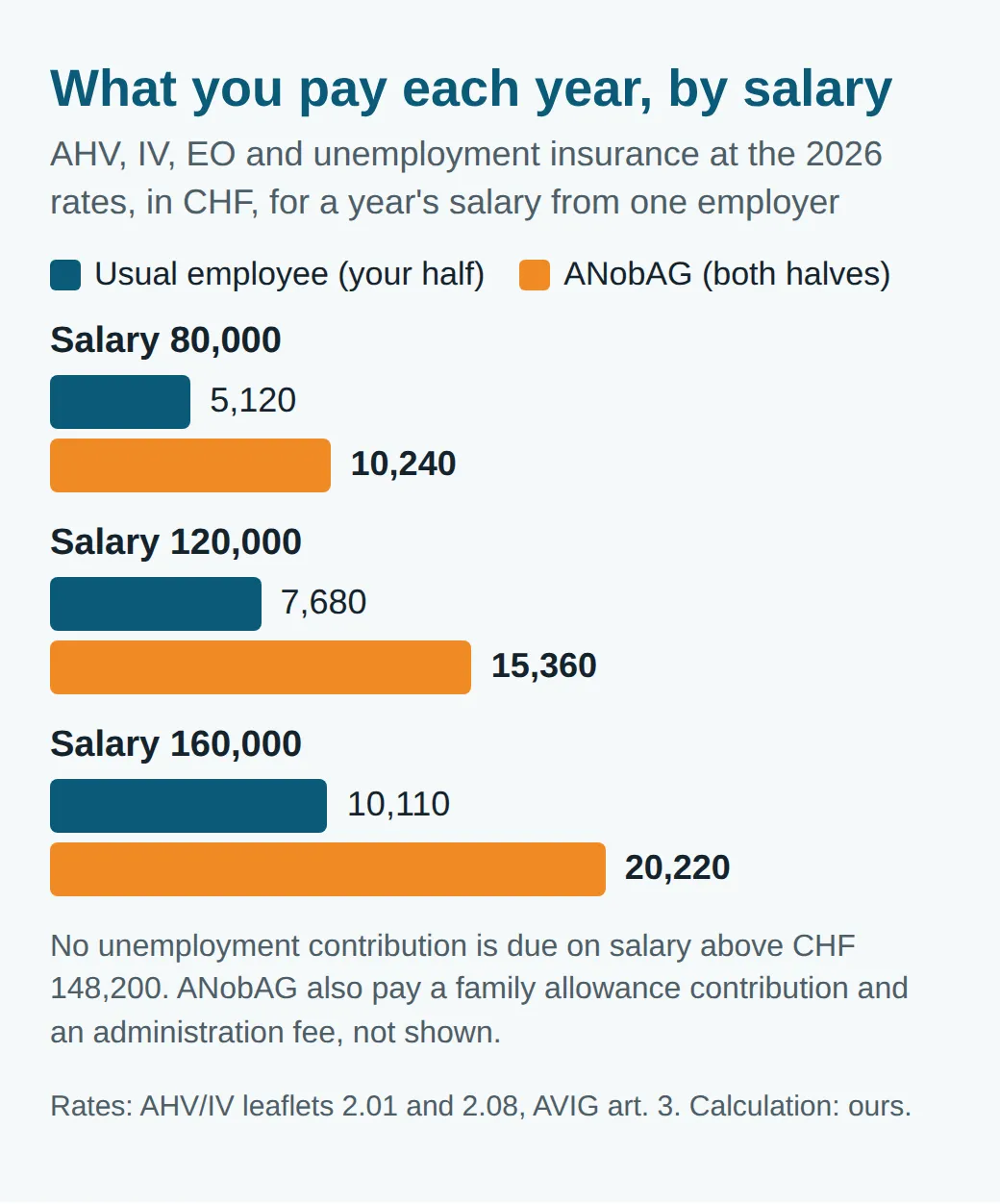
At a salary of CHF 120,000, that is 15,360 francs a year instead of 7,680. Two more items come on top for an ANobAG: the family allowance contribution and the administration fee, both covered below. And no employer pays into a pension fund for you, which is often the bigger gap.
The fair fix is a higher salary, but there's a catch in the arithmetic. A top-up paid as salary is salary too, so it attracts contributions of its own. To keep the same pay after social contributions as a usual employee, you need about 7.3 percent more gross, by our calculation for salaries under the CHF 148,200 cap. On an offer of 100,000 francs, ask for about 107,340: after 12.8 percent, that leaves 93,600, the same as a usual employee keeps from 100,000 after 6.4 percent.
Family allowances, accident and health insurance
The family allowance law covers you fully, as a payer and as a recipient. Under FamZG articles 11 to 13, you belong to the family allowance fund of the canton where you are registered for AHV, and you can claim child and education allowances like any employee. You also pay into that fund, as a percentage of your AHV salary, and SVA Zurich's leaflet for employees of employers abroad points out that the contribution is due even if you have no children. The rate is set by the fund and differs between cantons.
Accident insurance is compulsory in Switzerland, and Suva's guide says a person classed as an ANobAG is insured against accidents. The cover is taken out with Suva or with an approved private insurer, depending on the line of work. With an employer in the EU or EFTA, the employer is responsible, may hand the paperwork to you and stays liable for unpaid premiums. With an employer elsewhere, Suva puts paying the social insurance contributions on you. Settle which insurer covers you before your first working day, not after your first fall on the stairs.
Basic health insurance is yours to arrange and pay in any case, as for every resident. The BSV's model agreement says so explicitly for employees of foreign companies.
No pension fund, but a larger pillar 3a
The second pillar is where an ANobAG loses most. BVV 2 article 1j excludes employees whose employer owes no AHV contributions from the compulsory occupational pension. Nobody has to insure you, and no employer pays half.
You can insure yourself voluntarily, on the same terms as the self-employed, as the same article allows. The Substitute Pension Plan Foundation, the public fallback fund, must accept voluntary members under BVG article 60. You then pay the whole contribution yourself.
The other route is the third pillar. If you belong to no pension fund, BVV 3 article 7 lets you pay up to 20 percent of your earned income into pillar 3a, capped at 40 percent of the BVG upper limit. With that limit at CHF 90,720 (BVG article 8), the cap is CHF 36,288 in 2026, against 7,258 for someone with a pension fund. These payments are deductible from taxable income (DBG article 33). It's a good tool, but it is your money going in, not the employer's, so price the missing employer share into your salary talks too.
Tax: nobody withholds, so you file
Income tax follows where you physically work. The Federal Council's dispatch on taxing telework says tax treaties as a rule tax employment income in the state where the work is physically done. You live and work here, so Switzerland taxes your salary.
What changes is how it's collected. Foreign residents without a C permit are normally taxed at source (DBG article 83), with the tax deducted by the employer. An employer abroad with no Swiss business site doesn't do that. Zurich's tax office says pay from an employer not resident in Switzerland is assessed in the ordinary procedure, through a tax return, unless a tax treaty limits Switzerland's right to tax it. So expect to file every year, receive provisional tax bills, and put money aside each month, because no payslip does it for you.
The contributions you pay under the AHV, unemployment and accident insurance laws are deductible, the full ANobAG rate included, since DBG article 33 deducts contributions paid as the law requires. If the employer's payroll at home withholds its own country's tax, raise it before the first payslip rather than after your first Swiss tax return.
One risk sits with the employer. Zurich's leaflet says source tax does apply when a Swiss business site of the foreign employer bears your pay, and an employer with a business site here owes AHV contributions under article 12. Signing deals with Swiss clients from your spare room is the kind of work that raises that question. Our post on working abroad for a Swiss employer looks at this permanent establishment risk from the other side.
Your permit: the catch most guides skip
For permit purposes, working from home for a company abroad is often not treated as a job at all. The State Secretariat for Migration set this out in a circular to the cantonal migration offices of 5 April 2022, and the answer depends on your passport.
EU and EFTA citizens
Under the free movement agreement, an employee is someone working for an employer of the host country, which means one based here. If you work from home for a company abroad, with no link to the Swiss labour market and no clients here, the SEM says you are treated as a non-employed person instead. You then need enough money to live on and full health and accident insurance, and your salary from abroad counts towards the money. The SEM's free movement directives say a first permit for non-employed people usually runs five years and can be withdrawn if the means or the insurance run out. If you do serve Swiss clients, for example as the company's representative here, the SEM treats it as a posting from abroad, which follows other rules.
Everyone else
For non-EU nationals, Swiss law counts any work for an employer in Switzerland or abroad as gainful work, wherever the salary is paid, and every home office activity that touches the Swiss labour market needs a permit. With a B permit that allows you to change jobs, such as one for work or family reunification, you may work from home for a foreign employer whose business touches the Swiss labour market without a new permit. The catch is the ANobAG case itself. If your permit was granted for a job and you switch to an employer abroad with no Swiss branch and no effect on the Swiss labour market, the SEM says you need a new permit without gainful work, such as family reunification or training. Newcomers who move here only to work remotely for a foreign company with no effect on the Swiss labour market can be admitted only on such a permit, and a 2021 survey of the cantonal labour market offices cited in the circular found none had granted a work permit for pure home office to a newly arriving non-EU national.
With a Swiss passport none of this applies, and a C permit lets you work for anyone anywhere in Switzerland (AIG article 38). Everyone else should ask the cantonal migration office before signing, not after the first renewal letter.
What to put in the contract
Swiss law governs your contract unless you agree otherwise. Under PILA article 121, an employment contract follows the law of the country where you usually work. The parties may instead choose the law of your country of residence or of the employer's seat, and article 115 lets you sue in a Swiss court where you live. If Swiss law applies, so do Swiss rules on expenses, which in some cases include a share of your home office costs, as our post on the home office allowance explains.
Most foreign employers have never heard of ANobAG, so the contract is where you teach them. A short annex can carry it:
The employee lives and works in [town], Switzerland. The employer has no place of business in Switzerland. The employee registers with the cantonal AHV compensation office and pays all Swiss social contributions. To cover the employer's share, the gross salary includes a supplement of [7.3]%. The employer also pays CHF [amount] a year towards the employee's pension or pillar 3a. This contract is governed by Swiss law.
A real employer abroad may be unfamiliar with all this, but it will put it in writing. One that asks you to receive and forward payments instead is not hiring you, as our post on fake remote job offers shows.
Before you say yes
Work it through in order. Check where the employer is based and which box your passport puts you in. If you aren't Swiss, settle the permit with the cantonal migration office first. Then register with the compensation office from your first month, arrange accident insurance, and plan for a tax return with no withholding. Only then talk numbers: 12.8 percent instead of 6.4, a supplement of about 7.3 percent to close it, and a pension contribution that nobody pays unless you ask.
If you'd rather skip all of it, a remote job with an employer that has a Swiss office puts you back on normal payroll. Our board lists current openings in data and AI below, and in product and project management.
Whichever you choose, ask the question in the first interview: "Do you have a Swiss entity, or would I be an ANobAG?" The answer tells you more about the real salary than the number in the offer.
Common questions
- I also work part time for a Swiss company. Where do I register?
- With the compensation office you already belong to through that job. Suva's guide for ANobAG gives this rule, and only if you have no such link do you go to the cantonal compensation office where you live. The unemployment insurance cap of CHF 148,200 applies to each job separately.
- What if I worked for a foreign employer for years without registering?
- Register now. For ANobAG contributions, the AHV law lets the compensation office claim them until one year after the year in which the matching tax assessment became final, so older years can still be billed. Only contributions actually paid are credited to your pension account, so unpaid years would otherwise stay gaps.
- Can I get Swiss child allowances as an ANobAG?
- Yes. The family allowance law gives employees of non-contributing employers the same right to child and education allowances, paid by the fund of the canton where they are registered for AHV. You need an AHV salary of at least half the minimum AHV pension, which comes to CHF 7,560 a year in 2026.
- Does an employer in the UK count like one in the EU?
- Often, yes. The BSV's model agreement, under which you take over paying the contributions while the employer stays liable, is also drawn up under the Swiss-UK social security convention of 9 September 2021, so a UK employer can owe Swiss contributions much as an EU one does. Your nationality decides whether the convention covers you, so ask your compensation office before you start.
More posts
All posts
Digital nomad visa in Switzerland: the legal routes in 2026
Switzerland has no digital nomad visa. What the law allows instead: the 90/180 rule, the 8-day limit, EU residence without a job, quotas and staff leasing.

Right to work from home in Switzerland: the rules in 2026
Switzerland gives you no legal right to work from home. When your employer can order you back, when it needs your consent or notice, and what protects you.

Remote companies in Switzerland 2026: what the ads promise
Which Swiss employers post the most remote-friendly jobs, what 536 of their ads promise about home office, and the 42% posted by agencies.