Home office tax deduction in Switzerland: the 2026 rules
Before you claim it
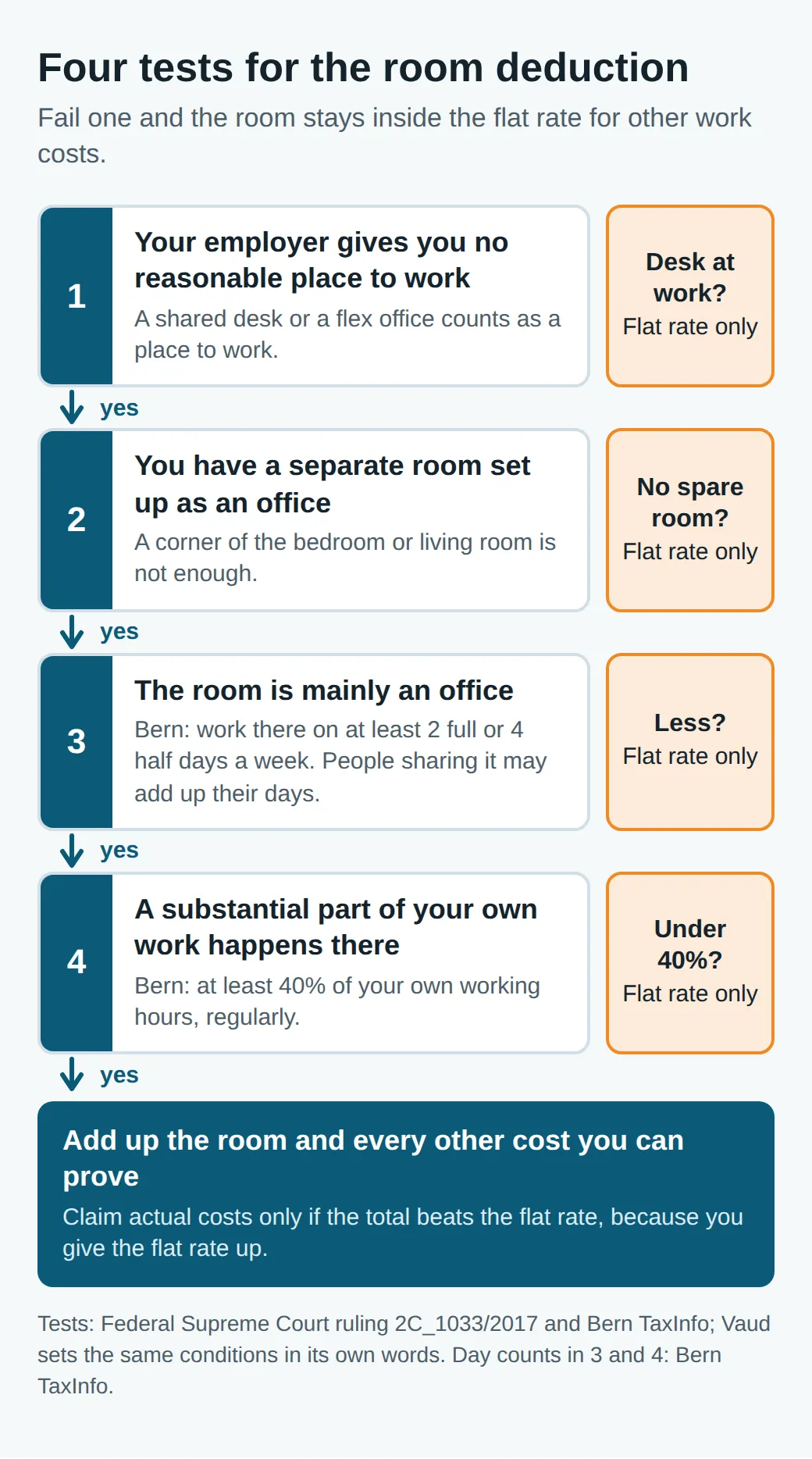
A home office is tax deductible in Switzerland only in a narrow case. Your employer must give you no reasonable place to work, you need a separate room used mainly as an office, and you must work there a large part of your time; Bern puts that at 40 percent of your hours. Even then, the room replaces the flat rate of 3 percent of net salary (CHF 2,000 to 4,000). It doesn't come on top.
That last point is easy to miss, and it decides whether claiming is worth the effort. So is the question of where the rules come from. The home office has no deduction of its own. There is a federal ordinance that lists the "private study" among work costs, a set of Federal Supreme Court rulings that decide when it counts, and cantonal tax offices that turn those rulings into practice. Below we go through each layer, with the rules and cases the tax offices of Zurich, Bern and Vaud have published or fought in court, and then do the arithmetic.
The flat rate already includes your home office
Every employee in Switzerland gets a flat deduction for "other work costs" without showing a single receipt. At federal level the professional costs ordinance sets it at 3 percent of your net salary, at least CHF 2,000 and at most CHF 4,000 a year, in the version in force since 1 January 2026. Net salary here means your gross pay minus the AHV, unemployment and pension fund contributions and the non-work accident premium, as Zurich's 2026 order on flat work costs spells out.
The same ordinance lists what the flat rate is meant to cover: tools, computer hardware and software, professional books, work clothes and the private study room, in German the privates Arbeitszimmer. So a home office is not a new deduction you add to your return. It's one of the things you've already been given a lump sum for.
Zurich, Bern and Vaud use the same 3 percent, CHF 2,000 and CHF 4,000 for cantonal tax. Zurich's order for tax periods from 2026 names the private study in the same list, Bern's ordinance takes the federal rates over directly, and Vaud's tax office lists the same amounts under code 160 of its return. If you work part time or only part of the year, the federal ordinance says the flat rate is cut accordingly.
The catch is in one sentence of the ordinance. If you claim more than the flat rate, you must prove all your actual costs and that the work needed them. Vaud's 2025 filing instructions say it most plainly: "La déduction forfaitaire n'est pas cumulable avec la déduction des frais effectifs." The flat deduction and actual costs can't be combined. Before any of that arithmetic matters, though, the room has to qualify.
When a home office counts as a work cost
A room at home is a work cost only if your job forces you to work there. The Federal Supreme Court has applied the same test since at least 1990, and it has two parts. You must regularly do a substantial part of your work at home because your employer doesn't give you a suitable place to work. And your home must have a separate room that serves mainly work, not private life. If a room is used mostly but not only for work, the private share stays a living cost.
Two things follow. Working from home because you prefer it, or because it saves you the commute, doesn't count, however many days you do it. And a desk in the corner of the living room or bedroom doesn't count either, because there is no separate room. The burden of proof is on you, as with every deduction that lowers your tax.
These conditions apply to the direct federal tax and to cantonal tax alike. In the Zurich case below, the court noted that Zurich's tax law matches the federal rule, so the answer was the same for both.
Zurich: a shared desk is still a desk
The case Bern's tax office now cites comes from Zurich. In ruling 2C_1033/2017 of 31 May 2018, an IT specialist and his wife had claimed CHF 6,115 for his home study in their 2015 return. The tax office in Uster refused it and gave him the flat rate of CHF 4,000 instead. The cantonal tax office, the tax appeals court and the administrative court all agreed, and so did the Federal Supreme Court.
His employer ran a "Smart-Working" office concept. Nobody had an assigned desk any more, and there were flexible desks for 80 percent of the staff, plus meeting rooms and common areas. His argument was simple: with fewer desks than people, someone has to work from home, and that someone was him. The court didn't accept it. The employer's own documents described its appetite for home working as "only 1-2 days/week max", and "working remotely" also covered meeting areas, trains and client visits. Overall, the court found, he could do 80 percent of his work at one of the desks in Zurich.
The court did accept that new office concepts can push people home for work that needs quiet. But a deduction still needs a regular, substantial share of the work done at home because of the employer, not because of personal convenience. It pointed to Basel-Landschaft's practice of 40 percent of working time as an example of what substantial means. The couple paid court costs of CHF 1,500.
For you, the lesson is that hot-desking, desk sharing and "work from anywhere" policies usually don't open the deduction. If your office has a desk you can book, expect the tax office to treat it as your workplace. Zurich's own texts give no day count and no room formula: its 2026 order and its 2025 tax return guide only say that higher actual costs must be proven in full, with a list attached to the return. For the numbers, Bern is the canton that has written them down.
Bern: two days a week and 40 percent of your hours
Bern's tax office is the most precise of the three. Its TaxInfo page on the study room splits the court's test into four conditions and puts figures on two of them.
First, your employer gives you no reasonable workplace, and the tax office suggests proving that with a confirmation from the employer. Bern adds, citing the Zurich ruling, that shared desks and smart-working concepts count as a reasonable workplace. Second, there is a room in your home set aside as an office. A work corner in a bedroom, living room or hall isn't enough, which means your home must have more rooms than your household needs to live in. Third, the room serves mainly work: Bern's bar is use for work on at least two full days of eight hours or four half days of four hours a week. Fourth, it is used regularly for a substantial part of your work: at least 40 percent of your own workload must be done from home.
Tests three and four look alike but measure different things. The third is about the room, the fourth about you. Bern's worked examples show why that matters. In the first, a person living alone works 60 percent, three days a week, and the employer confirms that on Tuesday afternoons and Wednesdays every desk is taken. So they work 1.5 days a week at home, in a room that also holds a sofa bed for guests. Half their own hours are at home, so test four is met. But the room is used for work on only one and a half days, so test three fails, and there is no deduction.
In the second example, two people taxed separately share a 3.5-room flat with a room set up as an office. Person A has the same 60 percent job and 1.5 home days. Person B works full time in the field and, under the contract, does office work at home every Friday. Together they use the room for work on two and a half days, so test three is met for both. But B works only 20 percent of the time at home, below the 40 percent line, and gets the flat rate. A gets the room deduction in full: the fact that someone else also uses the room doesn't reduce it.
What the room is worth
Once the room qualifies, Bern turns it into money with a fixed formula for tenants. You take your yearly rent without service charges and garage, divide it by the number of rooms plus two (for the kitchen, bathroom and so on), and add a flat CHF 300 for heating, light and cleaning.
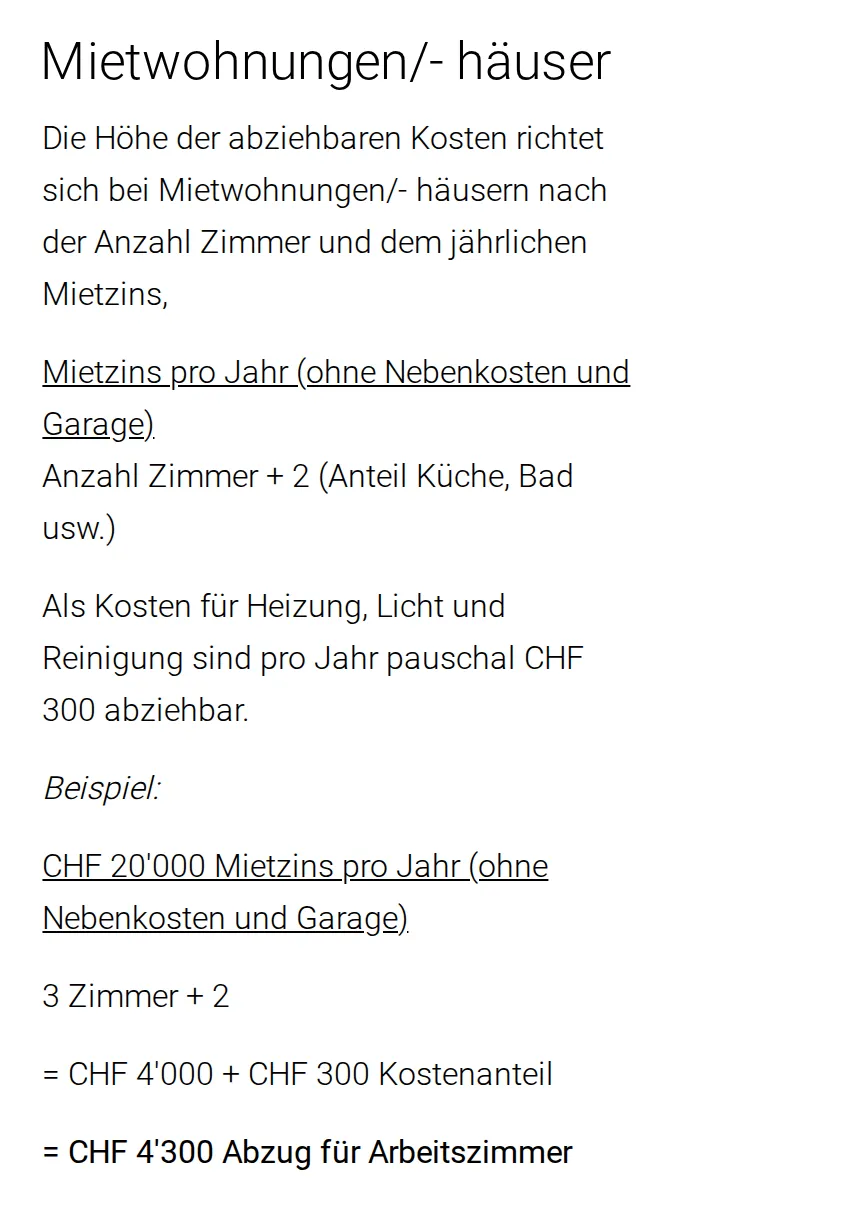
Bern's own example is a three-room flat at CHF 20,000 a year. That gives CHF 4,000 for the room plus CHF 300, so CHF 4,300. Homeowners use the rental value from their official valuation instead, as the FAQ below explains.
The Vaud and Zurich guides give no such formula. Vaud says only that the deduction covers "a part of the rent and charges" that belongs to the office, never the whole rent. If you live in another canton, Bern's method is a sensible way to show your own calculation, but your tax office may count differently, so put the steps on paper with your rental contract attached.
Does the room beat the flat rate?
Not always, and the gain is smaller than most people expect. Because the room replaces the flat rate, what you gain is the difference between the two, not the room's full cost.
Take three flats priced with Bern's formula. A three-room flat at CHF 1,200 a month comes to CHF 3,180. Bern's example is CHF 4,300. A four-room flat at CHF 2,200 a month comes to CHF 4,700. Against that sits your flat rate: CHF 2,000 up to a net salary of about CHF 66,700, then 3 percent, reaching the CHF 4,000 ceiling at about CHF 133,300.
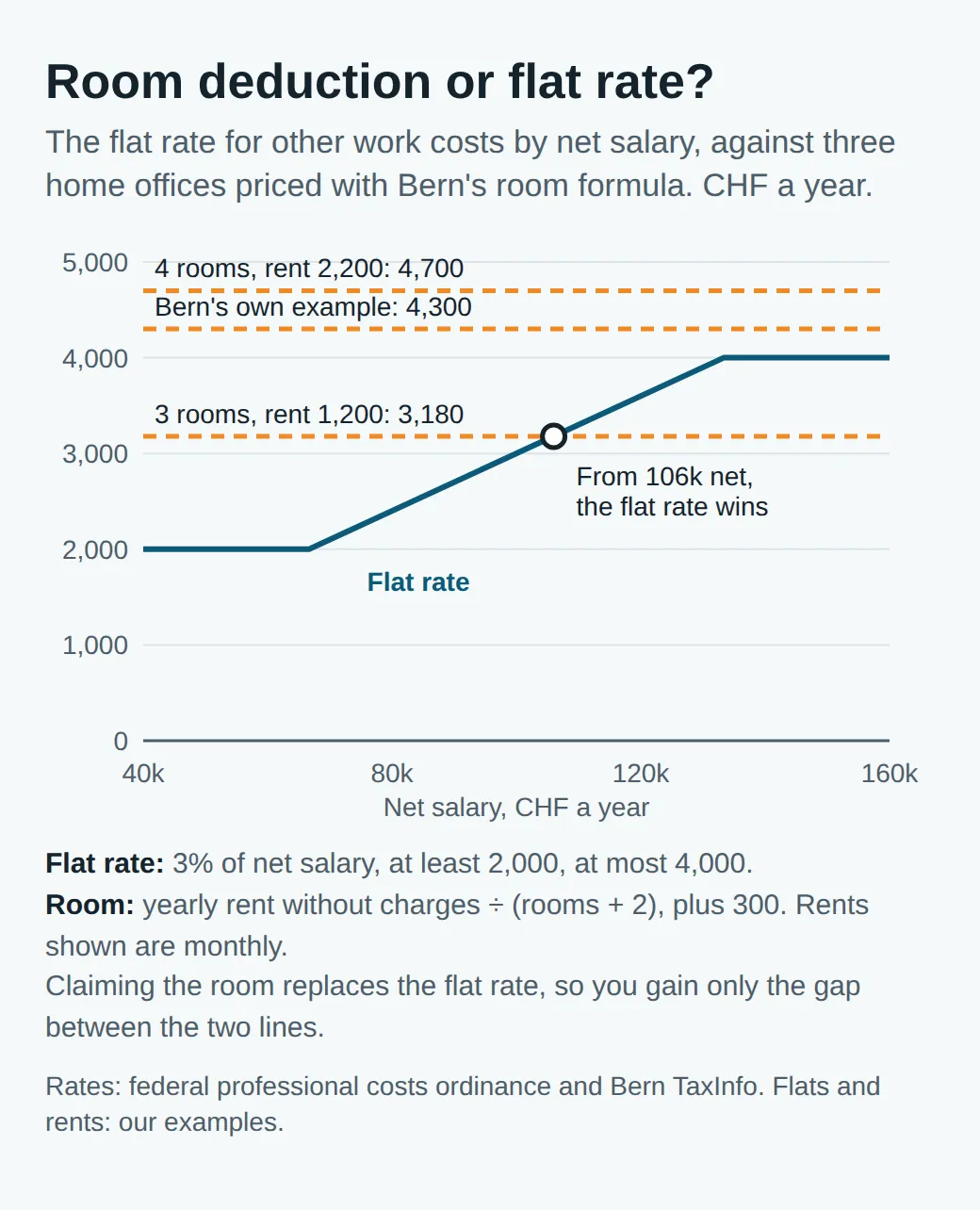
So with the cheaper flat, the room only pays below a net salary of CHF 106,000. Above it, the flat rate is worth more and you'd be proving costs to lose money. With the two dearer flats, the room wins at every salary, but above a net salary of about CHF 133,300 the gain shrinks to CHF 300 and CHF 700 of deduction. A deduction saves you your marginal tax rate on it, not the amount itself.
What can tip it is the rest of your actual costs, because once you leave the flat rate you can list everything else too: professional books, tools, professional association fees, and equipment your employer doesn't supply. Bern's guide sets the rules for a computer: deductible only in the year you buy it, only if you must use it mainly for work and your employer provides none, and minus 25 percent for private use. Vaud also asks for a private share on IT equipment. Add these up honestly before you decide.
Vaud: "accepted restrictively"
Vaud's tax office states its position on its deductions page in one phrase: actual costs for a chambre de travail privée are "acceptés de manière restrictive", accepted restrictively. Its conditions are the court's, in its own words. Working at home must be a necessity, even an obligation, and not a matter of personal convenience. You must have no suitable room at your workplace. And the room must be used regularly and essentially for work.
Vaud is also clear on what home office changes and what it doesn't. The flat deduction under code 160 isn't reduced because you work from home. What is reduced is your commuting deduction under code 140 and your meal deduction, in proportion to the days you don't travel. Vaud encourages employers to show telework days in box 15 of the salary certificate, though for 2025 that is voluntary.
What working from home does to your other deductions
For many remote workers, the bigger tax effect of home office isn't a new deduction but smaller old ones. The Zurich government said as much in its 2023 reply to a federal consultation: when you work at home, you can't claim travel costs or meals away from home for those days. It called the current rules "not neutral" between ways of working.
If you work three days a week from home, your travel and meal deductions should reflect two office days, not five, and Vaud's instructions say exactly that. How your canton treats a season ticket you'd buy anyway is worth checking in its own guide.
Money from your employer matters too. The federal ordinance excludes any cost the employer has already paid, and Zurich's order says the same. If your company pays you a monthly home office allowance, you can't deduct the costs it covers as well. Whether your employer has to pay at all is a different question, which we answer in our post on home office allowances.
Proof the tax office will ask for
Expect to show four things: that your employer has no desk for you, the layout of your home, your rent, and how often you work there. Zurich's government noted in the same 2023 reply that the salary certificate doesn't show home office days, so the tax office has to rely on other proof. Bern gives a written confirmation from the employer as an example of proof for the first test. Ask for it in plain words, and make sure it describes a requirement, not a perk:
We confirm that [name] works for us at [80]% of full time. We have no workplace available for [him/her/them] on [Monday, Thursday and Friday], so [he/she/they] must work from home on those days, which is [60]% of [his/her/their] working time. This is a requirement of the job, not a personal choice.
Keep your rental contract, a simple floor plan that shows which room is the office and what else is in it, and a calendar of your home days. Then tick actual costs rather than the flat rate on the work costs form, attach your list and calculation, and keep the receipts. In Zurich that is the line "effektiv gemäss Aufstellung" under other work costs; in Vaud it is code 160.
Will the rules change?
Possibly, but not for the 2026 tax year. In December 2022 the federal government put a reform to consultation: one fixed flat rate for all work costs, the same wherever you work, with actual costs as the alternative. The draft would also have let home costs count even where the employer provides a desk, according to Zurich's summary of it.
Zurich's reply rejected the choice between flat rate and actual costs, and in December 2023, after the consultation, the Federal Council changed the plan. Travel costs and the costs of a weekly stay away from home stay separate deductions. Meals away from home and other work costs, the group the home office belongs to today, go into one flat rate, and for those you could no longer prove higher actual costs. In a report of 19 June 2026, the Federal Council said it would adopt the bill for parliament in 2026. Each canton would still set its own amount.
If the bill passes in that shape, the room claim this article describes would end for the costs the new flat rate covers. Parliament still has to debate it, though, and until then the federal ordinance in force since 1 January 2026 and Zurich's order for tax periods from 2026 keep the 3 percent flat rate, so the tests above apply to your return for 2026.
What to do before you file
Start with the honest version of test one. If your employer has a desk you could book, keep the flat rate and move on. If it doesn't, count your home days and the share of your hours they represent, check that the office is a room of its own, and work out what it's worth with your canton's method or Bern's. Claim it only if the room plus your other provable costs clearly beat the flat rate.
If you're weighing a job where working from home is part of the deal, ask in the interview whether a desk is guaranteed on your home days or not. That answer settles more of your tax return than any receipt. Remote roles in IT operations in canton Bern are below, and there are more in software engineering in canton Vaud.
For tax on work done from another country, see our guide to working remotely from abroad for a Swiss employer.
Common questions
- I own my flat. How is the room valued?
- Bern uses the rental value instead of rent: the rental value per room unit from your official valuation, times 0.8 room units, times the cantonal rental value factor, plus CHF 300 for heating, light and cleaning. Bern's own example comes to CHF 1,516 a year. The tests for the room are the same as for tenants.
- Can I deduct a new laptop or monitor without claiming the room?
- Only by switching to actual costs for the whole category, which means giving up the flat rate and proving every cost. Bern accepts a computer only in the year you buy it, only if your employer gives you none, and only after taking off 25 percent for private use. A CHF 1,600 laptop then counts as CHF 1,200, still below the CHF 2,000 minimum flat rate.
- Do the pandemic exceptions still apply?
- No. Bern, for example, treated the no-workplace test as met from March 2020 to the end of 2021 and asked for no proof of it in that period. That exception has ended, so the normal tests apply again, including proof that your employer has no desk for you.
- Does any of this apply if I am self-employed?
- No. The tests and flat rates in this article are for employees. If you work for yourself, office costs are business expenses that you show in your own accounts under different rules, so ask your cantonal tax office or check its guide for the self-employed.
More posts
All posts
Digital nomad visa in Switzerland: the legal routes in 2026
Switzerland has no digital nomad visa. What the law allows instead: the 90/180 rule, the 8-day limit, EU residence without a job, quotas and staff leasing.

Right to work from home in Switzerland: the rules in 2026
Switzerland gives you no legal right to work from home. When your employer can order you back, when it needs your consent or notice, and what protects you.

Remote companies in Switzerland 2026: what the ads promise
Which Swiss employers post the most remote-friendly jobs, what 536 of their ads promise about home office, and the 42% posted by agencies.